ChipApex | Global Electronic Components Supplier
SEARCH
Search Product
Search Post
— IC芯片 | 连接器 | 传感器 | 被动器件 —
Search productSearch post
— IC芯片 | 连接器 | 传感器 | 被动器件 —
Consult the customer manager about the wholesale price.
consultation hotline:86-132-6715-2157
email:[email protected]
Contact the product manager for consultation. One-stop consultation is available.
Do you want a lower wholesale price? Please send us your inquiry and we will reply immediately.
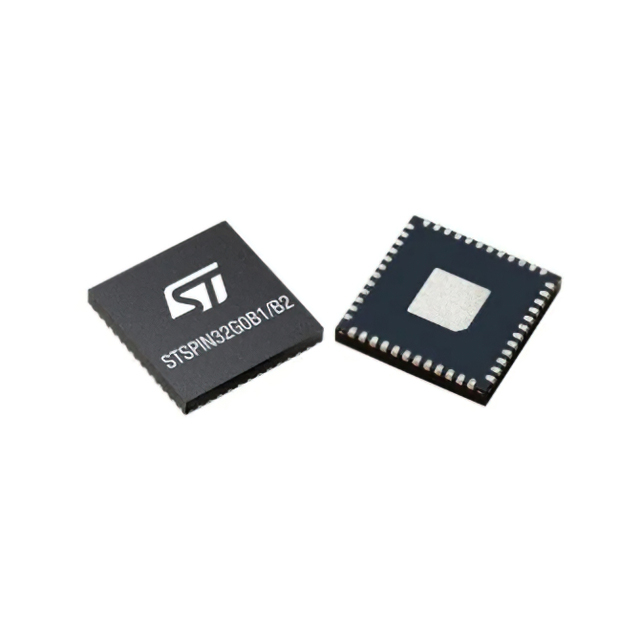
The STSPIN32G0B2TR is a highly integrated system-in-package motor controller designed for three-phase brushless DC motors. It combines an STM32G0B2 microcontroller with a 600 mA sink/source gate driver in a VFQFPN-48 package. The device operates within a supply voltage range of 6.7 V to 45 V and supports a maximum clock frequency of 64 MHz. Key electrical parameters include 64 kbyte flash memory, 8 kbyte SRAM, and a 12-bit ADC with up to 2.5 Msps conversion rate. It features integrated power management with a 3.3 V DC-DC buck converter and a 12 V LDO, ensuring robust operation across industrial temperatures from -40 °C to +125 °C.
Verify the specific suffix 'TR' indicates tape-and-reel packaging when sourcing components. Confirm that the part number matches the exact pinout and internal MCU configuration required for the design. Ensure compatibility with the intended operating voltage range and thermal requirements before finalizing procurement decisions.
Select this component when a single-package solution for both logic control and power driving is required to minimize bill of materials. Consider the 600 mA output current capability and the 45 V maximum voltage rating against load specifications. Evaluate the available GPIO count and peripheral set against application complexity needs.
This part belongs to the STSPIN32G0 family, which offers scalable solutions for three-phase motor control. It differs from other variants primarily by its specific embedded STM32G0B2 MCU resources and output current ratings. The family provides flexibility in balancing processing power and drive capabilities for various motor applications.
Direct substitutes within the same series include STSPIN32G0A1 or STSPIN32G0B2 (tray version) if packaging differences are acceptable. Verify pin-to-pin compatibility and internal memory configurations before substitution.
The integrated STM32G0 core supports a maximum clock frequency of 64 MHz.
Yes, the integrated three-phase gate drivers feature built-in cross-conduction prevention mechanisms.
 STSPIN32G0B2TR
The activity of extra discounts on wholesale prices is in full swing…
Please fill in your contact information and we will send you the latest wholesale price list.