 ChipApex | Global Electronic Components Supplier
SEARCH
Search Product
Search Post
— IC芯片 | 连接器 | 传感器 | 被动器件 —
Search productSearch post
— IC芯片 | 连接器 | 传感器 | 被动器件 —
Consult the customer manager about the wholesale price.
consultation hotline:86-132-6715-2157
email:[email protected]
Contact the product manager for consultation. One-stop consultation is available.
Do you want a lower wholesale price? Please send us your inquiry and we will reply immediately.
The SY89297UMH is a dual-channel programmable delay line supporting DC to 3.2 Gbps data rates and 1.6 GHz clock frequencies. It provides a 5 ns programmable delay range with 5 ps resolution, ensuring monotonicity within ±25 ps and integral non-linearity of ±15 ps. The device operates on a 2.5V or 3.3V supply, drawing up to 250 mA. It features a 3-pin serial interface for independent channel control and supports cascading. Packaged in a 24-lead QFN, it functions within an ambient temperature range of -40°C to +75°C.
Verify the specific suffix 'H' indicates the extended industrial temperature range of -40°C to +75°C, which differs from the standard 'G' variant. Confirm package availability as tube or reel configurations may vary by distributor. Ensure proper handling procedures are followed due to moisture sensitivity classification. Cross-reference datasheet revision DS20005835A for accurate electrical specifications before finalizing procurement orders.
Select this component when precise, programmable delay adjustment is required for high-speed CML signals. The dual-channel capability allows synchronized timing control for multiple data paths. Verify that the operating environment remains within the -40°C to +75°C limit. Consider the 24-lead QFN footprint for PCB layout constraints. Evaluate power consumption against system thermal budgets given the maximum current draw.
This part belongs to the Precision Edge family of delay lines manufactured by Microchip Technology. It serves as a dual-channel counterpart to single-channel variants like the SY89295U. The device utilizes advanced CML technology to maintain signal integrity at high frequencies. It is designed for applications requiring deterministic timing adjustments in complex digital systems.
The SY89297UMG is a direct functional replacement offering an extended temperature range of -40°C to +85°C. Both parts share identical pinouts, electrical characteristics, and packaging dimensions. Designers must verify that the target application's thermal environment falls within the -40°C to +75°C limit of the UMH variant before substitution.
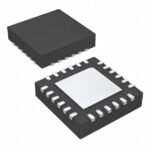 SY89297UMH
The activity of extra discounts on wholesale prices is in full swing…
Please fill in your contact information and we will send you the latest wholesale price list.





