 ChipApex | Global Electronic Components Supplier

SEARCH
Search Product
Search Post
— IC芯片 | 连接器 | 传感器 | 被动器件 —
Search productSearch post
— IC芯片 | 连接器 | 传感器 | 被动器件 —
Consult the customer manager about the wholesale price.
consultation hotline:86-132-6715-2157
email:[email protected]
Contact the product manager for consultation. One-stop consultation is available.
Do you want a lower wholesale price? Please send us your inquiry and we will reply immediately.
T5754-6AQ is listed in the RF Transmitter range at ChipApex. The manufacturer field lists Microchip Technology. Its product description is RF TX IC ASK 429-439MHZ 8TSSOP. Review the specifications below when checking this part for your BOM.
The T5754-6AQ is an RF transmitter IC from Microchip Technology designed for ASK and FSK modulation. It operates within the 429 MHz to 439 MHz frequency band, suitable for UHF applications. The device supports a supply voltage range of 2V to 4V and functions across an operating temperature range of -40°C to +85°C. It is housed in an 8-TSSOP surface-mount package with a width of 3.00mm. This component is part of the wireless and RF integrated circuits category.
Verify the specific suffix 'AQ' against official Microchip documentation to confirm package type and temperature rating. Ensure compatibility with existing circuit designs regarding the 2V to 4V supply range and 8-TSSOP footprint. Cross-reference lifecycle status as components may be obsolete or subject to replacement notices.
Select this component for applications requiring simple ASK or FSK modulation in the 433 MHz ISM band. Consider the 8-TSSOP package for surface mount assembly constraints. Evaluate the -40°C to +85°C operating range against environmental requirements. Confirm that the 2V to 4V supply voltage aligns with system power architecture.
The T5754 series includes variants like T5754-6AP and T5754-6AQJ. These are UHF transmitters often associated with Atmel Corporation before its acquisition by Microchip. The T5754-6AQ specifically denotes the commercial temperature grade variant in an 8-TSSOP package, distinct from industrial or extended temperature options.
Check for direct substitutes within the T5754 family such as T5754-6AP if industrial temperature ratings are required. Verify availability of equivalent ASK/FSK transmitters from other manufacturers if the T5754-6AQ is discontinued.
Explore related parts through RF and Wireless, all product categories, ChipApex homepage.
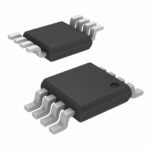 T5754-6AQ

The activity of extra discounts on wholesale prices is in full swing…
Please fill in your contact information and we will send you the latest wholesale price list.





