 ChipApex | Global Electronic Components Supplier
SEARCH
Search Product
Search Post
— IC芯片 | 连接器 | 传感器 | 被动器件 —
Search productSearch post
— IC芯片 | 连接器 | 传感器 | 被动器件 —
Consult the customer manager about the wholesale price.
consultation hotline:86-132-6715-2157
email:[email protected]
Contact the product manager for consultation. One-stop consultation is available.
Do you want a lower wholesale price? Please send us your inquiry and we will reply immediately.
The TAS5754MDCA is a digital-input, closed-loop Class-D audio amplifier manufactured by Texas Instruments. It features a PurePath™ HybridFlow architecture integrating an audio processor and high-performance DAC. The device supports stereo (BTL) or mono (PBTL) operation with a power supply voltage range of 4.5V to 26.4V for the power stage and 2.9V to 3.63V for analog circuits. It utilizes 1SPW modulation to reduce quiescent current. Key performance metrics include a THD+N of 0.007% at 1W/1kHz and an SNR of 103 dB. It accepts I²S, TDM, LJ, and RJ digital inputs with sampling rates from 8kHz to 192kHz. The component is housed in a 48-pin HTSSOP package.
Verify the suffix 'CA' indicates tube packaging rather than tape-and-reel. Confirm RoHS compliance status and moisture sensitivity level prior to assembly. Ensure the ordering part number matches the specific package variant required for the PCB footprint. Cross-reference the manufacturer's latest datasheet for any design changes or lifecycle notifications.
Select this model when low quiescent current is prioritized over the absolute lowest distortion found in BD-modulated variants. Suitable for designs requiring integrated DSP capabilities within a single amplifier IC. Verify that the system can accommodate the dual-supply requirement for PVDD and DVDD. Ensure the host controller supports the necessary I²C control interface and digital audio protocols.
This component belongs to the TAS575xM family of digital-input Class-D amplifiers. It shares the same core architecture and pinout with the TAS5754MDCAR but differs in packaging configuration. The TAS5754M series is designed for high-efficiency audio applications where software-configurable DSP features are beneficial. It competes with other integrated D-class amplifiers offering similar power outputs and digital interfaces.
TAS5754MDCAR is the tape-and-reel equivalent. TAS5756M offers BD modulation for lower distortion but higher idle current. TAS5751M is a stereo-only variant with different power capabilities. Verify pin compatibility and software configuration differences before substituting.
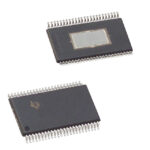 TAS5754MDCA
The activity of extra discounts on wholesale prices is in full swing…
Please fill in your contact information and we will send you the latest wholesale price list.





