 ChipApex | Global Electronic Components Supplier
SEARCH
Search Product
Search Post
— IC芯片 | 连接器 | 传感器 | 被动器件 —
Search productSearch post
— IC芯片 | 连接器 | 传感器 | 被动器件 —
Consult the customer manager about the wholesale price.
consultation hotline:86-132-6715-2157
email:[email protected]
Contact the product manager for consultation. One-stop consultation is available.
Do you want a lower wholesale price? Please send us your inquiry and we will reply immediately.
The TAS6424EQDKQRQ1 is a four-channel digital-input Class-D audio amplifier designed for automotive applications. It features a 2.1 MHz PWM switching frequency, enabling cost-optimized solutions with small PCB footprints and full operation down to 4.5 V for start/stop events. The device supports up to 40 kHz audio bandwidth and offers output power of 75 W into 4 Ω at 25 V BTL or 150 W into 2 Ω at 25 V PBTL. It includes advanced load diagnostics, enhanced EMI management, and I2C control.
Verify the specific ordering suffix DKQRQ1 against the manufacturer's current datasheet to confirm package type (HSSOP-56) and tape-and-reel specifications. Ensure compatibility with system voltage requirements, specifically the 4.5 V to 26.4 V supply range. Confirm that the AEC-Q100 Grade 1 qualification meets the target temperature range of –40°C to +125°C for the intended automotive environment.
Select this component when high channel count and digital interface integration are required in space-constrained automotive designs. The 2.1 MHz switching frequency allows for smaller passive components compared to lower-frequency alternatives. Consider the 7.2 A channel current limit and 150 W PBTL capability if driving low-impedance loads in parallel configurations. Verify I2C address pin settings to avoid conflicts in multi-device systems.
This part belongs to the Texas Instruments TAS6424E-Q1 family of four-channel digital input Class-D amplifiers. It is distinguished by its higher channel current limit (7.2 A typical) compared to other variants like the TAS6424L-Q1 or TAS6424M-Q1, which have lower limits of 4.8 A and 6.5 A respectively. This higher current capability enables greater output power in parallel bridge-tied load modes.
TAS6424EQDKQQ1
Yes, the device provides full operation down to a minimum supply voltage of 4.5 V, ensuring functionality during engine start/stop cycles.
The device features advanced load diagnostics that can detect open loads, shorted loads, short-to-battery, and short-to-ground conditions. It also supports AC diagnostics for detecting AC-coupled tweeters by measuring impedance and phase response.
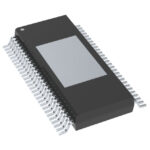 TAS6424EQDKQRQ1
The activity of extra discounts on wholesale prices is in full swing…
Please fill in your contact information and we will send you the latest wholesale price list.






