ChipApex | Global Electronic Components Supplier
SEARCH
Search Product
Search Post
— IC芯片 | 连接器 | 传感器 | 被动器件 —
Search productSearch post
— IC芯片 | 连接器 | 传感器 | 被动器件 —
Consult the customer manager about the wholesale price.
consultation hotline:86-132-6715-2157
email:[email protected]
Contact the product manager for consultation. One-stop consultation is available.
Do you want a lower wholesale price? Please send us your inquiry and we will reply immediately.
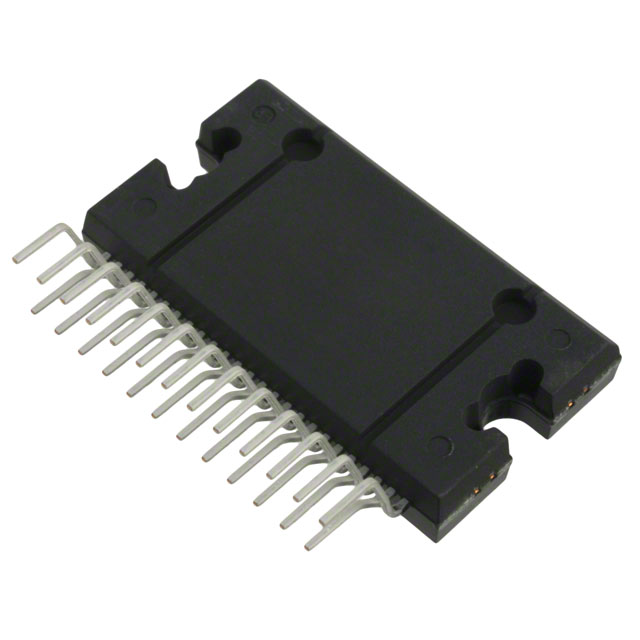
The TB67S142HG is a unipolar stepper motor driver IC manufactured by Toshiba Semiconductor and Storage. It features a fully integrated design combining control logic and power stages using power MOSFET technology. The device supports half-bridge output configuration with two outputs, delivering up to 3A current capability. It operates within a load voltage range of 10V to 40V and accepts a supply voltage between 4.75V and 5.25V. The component is housed in a 25-HZIP (25-SIP formed lead) package designed for through-hole mounting. It supports step resolutions of full, half, and quarter steps.
Verify the specific suffix HG against official Toshiba documentation to confirm the 25-HZIP through-hole package variant. Ensure compatibility with unipolar winding configurations and validate that the 10V to 40V load voltage range aligns with the target motor specifications. Cross-reference the 3A output current rating with thermal management requirements for the intended application environment.
Select this component when a through-hole solution is required for unipolar stepper motor applications. The TB67S142HG provides a robust alternative to surface-mount variants like the FTG model. Consider the 25-pin SIP form factor for PCB layouts accommodating larger packages. Confirm that the parallel interface and 4.75V to 5.25V logic supply meet the system's control circuit constraints.
This part belongs to the TB67S14x series of stepper motor drivers from Toshiba. It shares core electrical characteristics with other members such as the TB67S142NG and TB67S142FTG, differing primarily in packaging and mounting style. The series is categorized under Motor / Motion / Ignition Controllers & Drivers, specifically targeting general-purpose stepping motor control tasks.
TB67S142NG serves as a pin-compatible replacement offering the same electrical specifications in a SDIP-24 package. TB67S142FTG,EL provides identical performance metrics but utilizes a 48-WQFN surface-mount package. Verify mechanical fit and thermal dissipation differences when substituting these variants.
 TB67S142HG
The activity of extra discounts on wholesale prices is in full swing…
Please fill in your contact information and we will send you the latest wholesale price list.