 ChipApex | Global Electronic Components Supplier
SEARCH
Search Product
Search Post
— IC芯片 | 连接器 | 传感器 | 被动器件 —
Search productSearch post
— IC芯片 | 连接器 | 传感器 | 被动器件 —
Consult the customer manager about the wholesale price.
consultation hotline:86-132-6715-2157
email:[email protected]
Contact the product manager for consultation. One-stop consultation is available.
Do you want a lower wholesale price? Please send us your inquiry and we will reply immediately.
The TC1304-ZP0EUNTR is a dual-output power management IC from Microchip Technology, integrating a 500 mA synchronous buck regulator and a 300 mA low-dropout (LDO) linear regulator. It operates within an input voltage range of 2.7 V to 5.5 V and features a fixed switching frequency of 2.0 MHz for the buck converter. The device utilizes current-mode control with automatic transition between PWM and PFM modes to optimize efficiency across varying load conditions. It includes independent shutdown controls for both outputs and provides a power-good signal with a 300 ms delay. The component is housed in a 10-lead MSOP package and supports operation temperatures from -40°C to +85°C.
Verify the specific suffix code against official Microchip documentation to confirm output voltage configurations and pin compatibility. Ensure that the ordering quantity aligns with manufacturer reel specifications. Confirm RoHS compliance status and moisture sensitivity level ratings prior to integration into surface-mount assembly processes.
Select this component when a design requires simultaneous generation of two regulated voltages from a single input source. It is suitable for applications prioritizing board space reduction and simplified bill of materials. Consider the thermal performance characteristics inherent to the MSOP-10 package when determining heat dissipation requirements for the intended operating environment.
This part belongs to the TC1304 family of dual-output regulators designed by Microchip Technology. The series combines switching and linear regulation technologies to address diverse power needs in portable applications. Variants within the family typically share core architectural features while differing in output voltage settings or control interfaces defined by their specific ordering suffixes.
Consult official Microchip substitution guides for verified alternative part numbers. Cross-reference technical parameters such as output current capabilities, package dimensions, and electrical specifications to ensure functional equivalence without redesigning the surrounding circuitry.
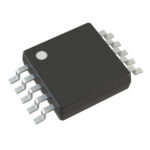 TC1304-ZP0EUNTR
The activity of extra discounts on wholesale prices is in full swing…
Please fill in your contact information and we will send you the latest wholesale price list.





