 ChipApex | Global Electronic Components Supplier
SEARCH
Search Product
Search Post
— IC芯片 | 连接器 | 传感器 | 被动器件 —
Search productSearch post
— IC芯片 | 连接器 | 传感器 | 被动器件 —
Consult the customer manager about the wholesale price.
consultation hotline:86-132-6715-2157
email:[email protected]
Contact the product manager for consultation. One-stop consultation is available.
Do you want a lower wholesale price? Please send us your inquiry and we will reply immediately.
The TC1313-1H0EUNTR is a dual-output power management IC from Microchip Technology, featuring a 500 mA synchronous buck regulator and a 300 mA low-dropout (LDO) linear regulator. It operates within an input voltage range of 2.7 V to 5.5 V, with a nominal rating of 3.6 V. The device utilizes current-mode control and pulse width modulation (PWM) techniques, supporting a maximum switching frequency of 2400 kHz. It incorporates automatic transition between PWM and PFM modes for optimized efficiency across load conditions. The component is housed in a 10-pin MSOP package.
Verify the specific suffix 'EUNTR' confirms the MSOP-10 plastic package and tape-and-reel shipping format. Ensure compatibility with RoHS standards and lead-free manufacturing processes as indicated by the manufacturer's compliance data. Confirm that the fixed 1.375 V buck output aligns with target circuit requirements before finalizing procurement orders.
Select this part when a design requires a combined switching and linear regulation solution in a space-constrained environment. The fixed 1.375 V output of the buck regulator suits applications needing a lower core voltage than standard 1.8 V or 2.5 V options. Consider the total quiescent current of 57 µA for battery life calculations and verify thermal performance within the specified -40°C to +85°C operating temperature range.
This component belongs to the TC1313 family of dual-output regulators designed for portable applications. The series offers various fixed output voltage combinations and packaging options, including DFN and MSOP variants. The TC1313-1H0EUNTR specifically provides a 1.375 V buck output paired with a 2.6 V LDO output, catering to niche voltage requirements in mixed-signal systems.
Direct substitutes include other TC1313 variants with different fixed output voltages, such as TC1313-1P2EUNTR or TC1313-ML1EUNTR, provided the voltage levels match the application needs. Cross-reference pinouts and thermal characteristics to ensure mechanical and electrical compatibility during replacement.
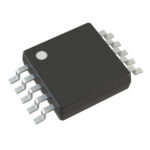 TC1313-1H0EUNTR
The activity of extra discounts on wholesale prices is in full swing…
Please fill in your contact information and we will send you the latest wholesale price list.





