 ChipApex | Global Electronic Components Supplier
SEARCH
Search Product
Search Post
— IC芯片 | 连接器 | 传感器 | 被动器件 —
Search productSearch post
— IC芯片 | 连接器 | 传感器 | 被动器件 —
Consult the customer manager about the wholesale price.
consultation hotline:86-132-6715-2157
email:[email protected]
Contact the product manager for consultation. One-stop consultation is available.
Do you want a lower wholesale price? Please send us your inquiry and we will reply immediately.
The TC74HC4052AFTEL is a dual 4-channel analog multiplexer/demultiplexer manufactured by Toshiba Semiconductor and Storage. It operates within a supply voltage range of 2.0 V to 6.0 V. The device features two independent multiplexers, each with four inputs and one common output controlled by two digital select lines and an active-low enable input. Key electrical parameters include a maximum propagation delay of 9 ns at 5 V, a typical on-resistance of 60 ohms, and low static power consumption of 1 µA. It supports an operating temperature range from -40°C to +85°C and is housed in a TSSOP-16 package.
Verify the specific ordering suffix AFTEL corresponds to the TSSOP-16 package and tape-and-reel packaging configuration. Confirm RoHS compliance status and ensure the component meets AEC-Q100 requirements if automotive qualification is necessary. Cross-reference the manufacturer part number with official Toshiba documentation to validate pinout compatibility and electrical specifications before integration.
Select this component when a dual 4:1 analog switch is required with HC logic level compatibility. Ensure the application voltage does not exceed 6.0 V and that the on-resistance variation meets system accuracy needs. Consider the TSSOP-16 footprint constraints and thermal dissipation capabilities relative to the expected load current and ambient temperature conditions.
This part belongs to the 74HC series of high-speed CMOS logic devices produced by Toshiba Semiconductor and Storage. It is functionally compatible with other industry-standard 74HC4052 variants but may differ in packaging or specific electrical tolerances. The device is designed for general-purpose analog switching applications where low power and moderate speed are prioritized over high-voltage handling capabilities.
Direct substitutes include the 74HC4052D and 74HC4052N from Toshiba, which offer similar electrical characteristics but may utilize SOIC or DIP packages. Verify pinout compatibility and package dimensions when replacing the TSSOP-16 variant with alternative footprints to ensure mechanical fit and electrical connectivity remain unchanged.
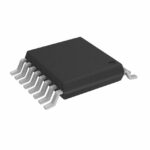 TC74HC4052AFTEL
The activity of extra discounts on wholesale prices is in full swing…
Please fill in your contact information and we will send you the latest wholesale price list.





