 ChipApex | Global Electronic Components Supplier
SEARCH
Search Product
Search Post
— IC芯片 | 连接器 | 传感器 | 被动器件 —
Search productSearch post
— IC芯片 | 连接器 | 传感器 | 被动器件 —
Consult the customer manager about the wholesale price.
consultation hotline:86-132-6715-2157
email:[email protected]
Contact the product manager for consultation. One-stop consultation is available.
Do you want a lower wholesale price? Please send us your inquiry and we will reply immediately.
The TC7QPB9307FT(EL) is a digital bus switch IC manufactured by Toshiba Semiconductor and Storage. It features four independent bidirectional channels configured as 4-bit dual-supply bus switches. The device supports low voltage operation with VCCA ranging from 1.65V to 5V and VCCB from 2.3V to 5.5V, enabling level shifting between different voltage domains. Key electrical parameters include a maximum on-resistance of 16 ohms, a maximum propagation delay of 1.2 ns, and a maximum power dissipation of 180 mW. It operates within a temperature range of -40°C to +85°C and is housed in a 14-pin VSSOP package.
Verify the specific suffix FT(EL) against the manufacturer's official datasheet to confirm packaging details such as tape and reel specifications. Ensure the component meets RoHS3 compliance requirements if mandated by your project standards. Cross-reference the ordering code with Toshiba Semiconductor and Storage documentation to validate availability and lead times prior to procurement.
Select this component when designing circuits requiring bidirectional level translation between mixed-voltage domains. The dual-supply architecture allows independent power rails for input and output sides. Consider the 16-ohm on-resistance and 1.2ns delay for signal integrity analysis. The 14-pin VSSOP package is suitable for space-constrained surface-mount designs requiring industrial temperature range operation.
This part belongs to the TC7QPB series of low-voltage, low-power CMOS digital bus switches. It is designed to replace older discrete level-shifting solutions by integrating multiple channels into a single compact IC. The series emphasizes low power consumption and high-speed performance, making it appropriate for modern portable electronics and communication interfaces requiring reliable voltage domain isolation.
Yes, the device supports bidirectional data flow, allowing signals to pass between A and B ports regardless of direction, provided external pull-up resistors are connected appropriately.
The maximum propagation delay is specified as 1.2 ns, ensuring fast switching speeds for high-frequency data lines.
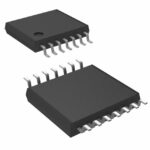 TC7QPB9307FT(EL)
The activity of extra discounts on wholesale prices is in full swing…
Please fill in your contact information and we will send you the latest wholesale price list.





