 ChipApex | Global Electronic Components Supplier
SEARCH
Search Product
Search Post
— IC芯片 | 连接器 | 传感器 | 被动器件 —
Search productSearch post
— IC芯片 | 连接器 | 传感器 | 被动器件 —
Consult the customer manager about the wholesale price.
consultation hotline:86-132-6715-2157
email:[email protected]
Contact the product manager for consultation. One-stop consultation is available.
Do you want a lower wholesale price? Please send us your inquiry and we will reply immediately.
The TC7USB221FT(EL,M) is a high-speed CMOS dual single-pole double-throw (SPDT) USB switch manufactured by Toshiba Semiconductor and Storage. It functions as a dual 1-to-2 multiplexer/demultiplexer with a common select input (S) and output enable (OE). The device operates within a power supply voltage range of 2.3 V to 3.6 V and supports an operating temperature range from -40°C to +85°C. Key electrical characteristics include a typical ON-resistance of 6.5 Ω at 3 V, an ON-capacitance of 7 pF, and a propagation delay time of 0.25 ns. It features ESD protection ratings of ±200 V for the machine model and ±2000 V for the human body model.
Verify that the specific ordering suffix matches the required package configuration. Confirm RoHS compliance status through official documentation before procurement. Ensure the selected variant aligns with the specified voltage and temperature requirements for the target application environment.
Select this component when a compact solution for routing differential USB signals between two ports is required. The device is suitable for designs needing low insertion loss and minimal signal distortion. Verify that the system voltage remains within the 2.3 V to 3.6 V operational range to ensure correct functionality.
This part belongs to the TC7USB series of USB switches produced by Toshiba Semiconductor and Storage. It is designed as a general-purpose digital integrated circuit for managing data lines in consumer electronics. The component utilizes CMOS technology to achieve high speed and low power consumption.
Consult official Toshiba documentation for verified substitute part numbers. Do not assume pin compatibility or electrical equivalence with other manufacturers' components without cross-referencing datasheets.
When the OE input is held at a high level, the switches are disconnected regardless of the Select (S) input state, resulting in a high-impedance state between the ports.
The device provides ESD protection up to ±2000 V according to the Human Body Model (HBM) and ±200 V according to the Machine Model (MM).
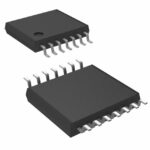 TC7USB221FT(EL,M)
The activity of extra discounts on wholesale prices is in full swing…
Please fill in your contact information and we will send you the latest wholesale price list.





