 ChipApex | Global Electronic Components Supplier
SEARCH
Search Product
Search Post
— IC芯片 | 连接器 | 传感器 | 被动器件 —
Search productSearch post
— IC芯片 | 连接器 | 传感器 | 被动器件 —
Consult the customer manager about the wholesale price.
consultation hotline:86-132-6715-2157
email:[email protected]
Contact the product manager for consultation. One-stop consultation is available.
Do you want a lower wholesale price? Please send us your inquiry and we will reply immediately.
The TC9590XBG is an automotive-grade CMOS digital integrated circuit functioning as a bridge device that converts HDMI streams to MIPI CSI-2 TX. Designed for modern automotive application processors lacking native video streaming inputs, it accepts HDMI input and outputs a CSI-2 stream compatible with camcorder interfaces. The device supports HDMI 1.4a video formats up to 1080P @60fps and includes features such as HDCP support, EDID management, and audio processing via I2S or TDM interfaces.
Verify the specific ordering suffix 'EL' against Toshiba Semiconductor and Storage documentation to confirm packaging details, as datasheets may not explicitly define suffix variations. Ensure compliance with AEC-Q100 Grade 3 qualification requirements (-40°C to 85°C ambient operating temperature) for automotive integration.
Select this component when the target Application Processor lacks an HDMI input but provides a MIPI CSI-2 receiver. Confirm power supply compatibility with the required domains: 1.2V for core/MIPI D-PHY, 1.8V or 3.3V for I/O, 3.3V for HDMI, and 2.5V for APLL. Verify that the host system can accommodate the 64-LFBGA (7x7 mm) package dimensions.
The TC9590XBG belongs to Toshiba's Automotive Peripheral Devices series. It addresses the architectural shift in automotive SoCs where dedicated video decoder ports are replaced by standard MIPI CSI-2 interfaces originally intended for camera sensors. This allows legacy HDMI sources to be processed by modern high-performance computing platforms.
Publicly confirmed substitute part numbers are not available in the provided documentation. Evaluate alternative bridge devices based on MIPI CSI-2 output compatibility and HDMI 1.4a support if sourcing constraints exist.
No, the device does not support Audio Return Path or HDMI Ethernet Channels.
The device supports video formats up to 1080P @60fps, including RGB and YCbCr444/422 at 24-bpp.
Audio is transmitted via multiplexed pins configured as either an I2S interface (single lane for stereo) or a TDM interface (fixed 8 channels). Both modes operate in Master Clock mode only.
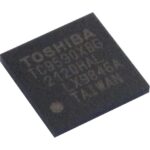 TC9590XBG(EL)
The activity of extra discounts on wholesale prices is in full swing…
Please fill in your contact information and we will send you the latest wholesale price list.





