 ChipApex | Global Electronic Components Supplier
SEARCH
Search Product
Search Post
— IC芯片 | 连接器 | 传感器 | 被动器件 —
Search productSearch post
— IC芯片 | 连接器 | 传感器 | 被动器件 —
Consult the customer manager about the wholesale price.
consultation hotline:86-132-6715-2157
email:[email protected]
Contact the product manager for consultation. One-stop consultation is available.
Do you want a lower wholesale price? Please send us your inquiry and we will reply immediately.
The TDA1566TH/N1C,118 is a car audio power amplifier featuring two Bridge Tied Load (BTL) output stages realized in BCDMOS technology. It supports dual channel operation with 4 Ω or 2 Ω loads, or single channel configuration driving a 1 Ω load. The device offers I²C-bus and non-I²C-bus control modes, selectable gain settings of 16 dB and 26 dB, and comprehensive load diagnostic features including DC and AC load detection. It includes pop-free mode transitions and extensive protection mechanisms.
Verify the specific ordering suffix N1C,118 against official manufacturer documentation to confirm package type and tape/reel specifications. Ensure compatibility with existing PCB footprints for the HSOP24 package. Confirm that the TH version pinout matches the design requirements for address selection pins ADS1 and ADS2.
Select this component when requiring integrated load diagnostics and flexible gain settings in an automotive environment. Consider the I²C-bus capability for remote monitoring of fault conditions such as short circuits and thermal warnings. Evaluate the need for 1 Ω operation which requires parallel connection of output channels on the PCB.
The TDA1566 belongs to NXP's family of car audio power amplifiers utilizing BCDMOS technology. It is designed to replace older generation devices while offering enhanced diagnostic capabilities and lower offset voltages. The TH version is pin-compatible with the TDA8566TH1, facilitating direct upgrades in existing designs.
The TH version is officially confirmed as pin-compatible with the TDA8566TH1. When substituting, verify that the replacement part supports the required I²C-bus addressing and diagnostic feature sets.
To configure the TDA1566 for single channel 1 Ω operation, the outputs of both BTL channels must be connected in parallel on the printed-circuit board. The input signal is taken from channel 1, and the 1Ω select pin must be connected appropriately.
Via the I²C-bus, the device provides data on DC and AC load detection results, clip detection levels, temperature pre-warning status, and various fault conditions such as short circuits to ground, supply, or open loads.
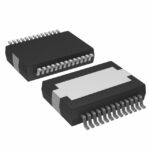 TDA1566TH/N1C,118
The activity of extra discounts on wholesale prices is in full swing…
Please fill in your contact information and we will send you the latest wholesale price list.





