 ChipApex | Global Electronic Components Supplier
SEARCH
Search Product
Search Post
— IC芯片 | 连接器 | 传感器 | 被动器件 —
Search productSearch post
— IC芯片 | 连接器 | 传感器 | 被动器件 —
Consult the customer manager about the wholesale price.
consultation hotline:86-132-6715-2157
email:[email protected]
Contact the product manager for consultation. One-stop consultation is available.
Do you want a lower wholesale price? Please send us your inquiry and we will reply immediately.
The TDA7295S is a monolithic Class AB audio amplifier in a Multiwatt15 package. It operates on a supply voltage range of ±10V to ±40V, delivering up to 80W music power into 4Ω or 8Ω loads at 10% THD. Key electrical parameters include an open-loop gain of 80dB, input offset voltage of ±10mV, and quiescent current of 30mA typical. The device features a DMOS power stage with short circuit protection, thermal shutdown at 150°C, and mute/stand-by functions.
Verify the obsolete status of this component before design finalization. Confirm that the Multiwatt15 V package dimensions match the target PCB footprint. Ensure the design accounts for the required heatsink thermal resistance, as continuous RMS power exceeding 50-60W necessitates high-efficiency circuit topologies to manage junction temperatures effectively.
Select this component for applications requiring high voltage operation up to ±40V and significant current delivery capabilities. It is suitable for designs needing low distortion and integrated protection without external Boucherot cells under standard conditions. Consider the modular application mode if driving very low impedance loads requires increased current capacity beyond single-device limits.
This part belongs to the TDA7295 series of DMOS audio amplifiers manufactured by STMicroelectronics. It utilizes Multipower BCD technology to achieve high performance in a linear integrated circuit format. The device is designed to replace discrete solutions while offering simplified implementation through integrated protection and control logic.
TDA7295 (Standard version)
Multiple devices can operate in parallel by connecting them via pin 11. One device acts as the master, while others act as slaves. Slave inputs are grounded, and their bootstrap capacitors must be scaled by the number of devices.
The clip detector provides a signal indicating when the output is clipping. This feature helps in monitoring amplifier performance and protecting downstream components from excessive distortion.
Yes, the device is designed to operate stably without Boucherot cells under normal conditions. However, they may be required if speakers are connected via long wires to prevent spurious oscillations during terminal shorts.
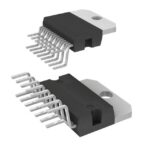 TDA7295S
The activity of extra discounts on wholesale prices is in full swing…
Please fill in your contact information and we will send you the latest wholesale price list.





