 ChipApex | Global Electronic Components Supplier
SEARCH
Search Product
Search Post
— IC芯片 | 连接器 | 传感器 | 被动器件 —
Search productSearch post
— IC芯片 | 连接器 | 传感器 | 被动器件 —
Consult the customer manager about the wholesale price.
consultation hotline:86-132-6715-2157
email:[email protected]
Contact the product manager for consultation. One-stop consultation is available.
Do you want a lower wholesale price? Please send us your inquiry and we will reply immediately.
The TDA7365 is a dual audio amplifier in a Multiwatt15 package designed for stereo car radio applications. It delivers an output power of 2x6W at 4Ω and 2x9W at 2Ω with 10% THD at 14.4V. The device features internally fixed gain, rail-to-rail voltage swing without bootstrap capacitors, and a solid-state switch capable of 1A continuous current. Operating supply ranges from 8V to 18V, with junction temperatures spanning -40°C to 150°C.
Verify the component matches the STMicroelectronics TDA7365 designation and Multiwatt15 package type. Confirm the operating voltage range aligns with automotive standards. Ensure the application circuit accounts for the internal fixed gain and solid-state switch requirements. Check datasheet specifications for absolute maximum ratings before integration.
Select this component for stereo automotive audio systems requiring high efficiency and minimal external components. The integrated solid-state switch simplifies power management for low-signal sections. Verify that the required output power fits within the 4Ω or 2Ω load constraints. Consider the thermal resistance characteristics for proper heat dissipation in the Multiwatt15 package.
This part belongs to the family of Class-AB audio power amplifiers specifically engineered for automotive environments. It integrates audio amplification with power switching capabilities, reducing the need for separate regulators or switches. The design focuses on minimizing external component count while maintaining robust performance under varying automotive electrical conditions.
Public confirmed substitute part numbers are not available in the provided documentation.
No, the fully complementary output configuration allows for rail-to-rail voltage swing without the need for bootstrap capacitors.
The solid-state switch supplies both the signal processing part of the car radio set and the lamps, simplifying power-on operation.
It features CMOS-compatible mute and standby functions that ensure no audible pop occurs during these transitions.
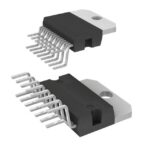 TDA7365
The activity of extra discounts on wholesale prices is in full swing…
Please fill in your contact information and we will send you the latest wholesale price list.





