 ChipApex | Global Electronic Components Supplier
SEARCH
Search Product
Search Post
— IC芯片 | 连接器 | 传感器 | 被动器件 —
Search productSearch post
— IC芯片 | 连接器 | 传感器 | 被动器件 —
Consult the customer manager about the wholesale price.
consultation hotline:86-132-6715-2157
email:[email protected]
Contact the product manager for consultation. One-stop consultation is available.
Do you want a lower wholesale price? Please send us your inquiry and we will reply immediately.
The TDA7376B is a dual bridge Class-AB audio amplifier designed for automotive radio applications. It delivers high output power, rated at 2 x 35 W into 4 Ω (EIAJ standard) and up to 2 x 40 W maximum. The device operates on a single supply voltage ranging from 8 V to 18 V. Key electrical parameters include an internally fixed gain of 26 dB, a differential input configuration, and a total harmonic distortion plus noise of 0.08%. It features rail-to-rail voltage swing without bootstrap capacitors and includes programmable clipping detection.
Verify component authenticity through authorized STMicroelectronics distributors or certified partners. Confirm package integrity and pin alignment against the Multiwatt-15 specification. Check for recent Product Change Notifications regarding manufacturing site updates. Ensure compliance with RoHS directives as indicated in official datasheets. Validate part markings against current production batches to avoid obsolete stock.
Select this component for designs requiring high power density in automotive environments. The internal fixed gain simplifies circuit design by minimizing external components. Differential inputs are suitable for noisy vehicle electrical systems. Consider thermal management requirements due to the power dissipation levels. Verify compatibility with CMOS-compatible mute and standby control signals.
The TDA7376B belongs to the TDA7376 series of audio amplifiers from STMicroelectronics. It utilizes a Multiwatt-15 package optimized for heat dissipation in automotive applications. The device represents a newer technology within its family, offering improved efficiency and feature integration compared to earlier iterations. It is specifically engineered to meet the rigorous demands of car radio power amplification.
Public documentation indicates the TDA7376PD as a related variant within the same product line. Both devices share similar power ratings and application targets. Verify pinout compatibility and specific electrical tolerances before substitution. Review official discontinuation notices for availability constraints.
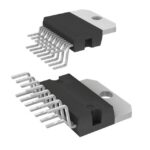 TDA7376B
The activity of extra discounts on wholesale prices is in full swing…
Please fill in your contact information and we will send you the latest wholesale price list.






