 ChipApex | Global Electronic Components Supplier
SEARCH
Search Product
Search Post
— IC芯片 | 连接器 | 传感器 | 被动器件 —
Search productSearch post
— IC芯片 | 连接器 | 传感器 | 被动器件 —
Consult the customer manager about the wholesale price.
consultation hotline:86-132-6715-2157
email:[email protected]
Contact the product manager for consultation. One-stop consultation is available.
Do you want a lower wholesale price? Please send us your inquiry and we will reply immediately.
The TDF8541JS/N2,512 is an I2C-bus controlled quad Bridge-Tied Load (BTL) audio power amplifier designed for automotive applications. It utilizes a complementary DMOS output stage in an SOI-based BCD process to ensure robust performance and high sound quality. The device operates at battery voltages as low as 6 V, supporting stop/start-car functionality without audible disturbances. It features four independent channels capable of driving 2 Ω and 4 Ω loads, with programmable gain options of 26 dB or 16 dB. The amplifier includes comprehensive diagnostics, start-up checks, and protection against short circuits, overvoltage, and thermal issues.
Verify the specific ordering suffix and package variant when sourcing this component. Confirm that the selected part matches the required pin configuration and thermal characteristics for your design. Ensure compatibility with your system's I2C addressing scheme and voltage levels. Check for any end-of-life notices or alternative recommendations from the manufacturer before finalizing procurement plans.
Choose this amplifier for designs requiring precise I2C control and extensive diagnostic feedback. It is suitable for environments where low-voltage operation during cranking is critical. Consider the thermal management requirements given the power output capabilities. Ensure your PCB layout supports the DBSMS27P package for optimal heat dissipation and electrical performance.
This component belongs to NXP's TDF8541 series of complementary quad BTL audio power amplifiers. It is engineered specifically for automotive use, leveraging Silicon-On-Insulator technology for latch-up immunity and channel isolation. The series offers scalable solutions for various car audio configurations, providing flexibility in gain settings and diagnostic features to meet diverse OEM requirements.
Consult official NXP documentation for confirmed substitute part numbers. Verify that any replacement maintains the same package type, pinout, and electrical specifications. Ensure the alternative device supports the required I2C interface and diagnostic functions. Cross-reference thermal and mechanical constraints to guarantee compatibility with existing board layouts.
The amplifier remains operational at battery voltages as low as 6 V. It uses a filtered half-supply voltage reference to prevent audible plops during engine start, ensuring smooth operation without disturbance.
The device provides start-up diagnostics including load detection (open, short, present), speaker fault detection, and programmable clip and thermal pre-warning. Status information can be read via I2C or indicated on diagnostic pins.
Yes, the TDF8541 can operate in either legacy (non-I2C) or I2C-bus modes. In legacy mode, the STB pin functions as a three-level control for stand-by, on, and mute states.
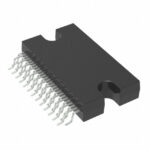 TDF8541JS/N2,512
The activity of extra discounts on wholesale prices is in full swing…
Please fill in your contact information and we will send you the latest wholesale price list.






