 ChipApex | Global Electronic Components Supplier
SEARCH
Search Product
Search Post
— IC芯片 | 连接器 | 传感器 | 被动器件 —
Search productSearch post
— IC芯片 | 连接器 | 传感器 | 被动器件 —
Consult the customer manager about the wholesale price.
consultation hotline:86-132-6715-2157
email:[email protected]
Contact the product manager for consultation. One-stop consultation is available.
Do you want a lower wholesale price? Please send us your inquiry and we will reply immediately.
The TDF8590TH is a high-efficiency Class-D audio power amplifier designed for car audio systems. It delivers 2 × 80 W into 4 Ω in Single-Ended (SE) mode or 160 W into 8 Ω in Bridge-Tied Load (BTL) mode. The device operates with a supply voltage range of ±14 V to ±29 V and features low quiescent current consumption. It includes differential inputs, fixed gains of 26 dB (SE) and 32 dB (BTL), and comprehensive protection circuits such as thermal foldback, overcurrent, and short-circuit protection.
Verify the exact ordering suffix against the manufacturer's official documentation to confirm package type and reel specifications. Confirm that the HSOP24 package variant matches your PCB footprint requirements. Ensure compatibility with the required supply voltage range and load impedance before finalizing procurement decisions.
Select this component for applications requiring high power density and efficiency in automotive environments. Consider the HSOP24 package size and internal heat sink capabilities when designing thermal management solutions. Evaluate the need for external synchronization if multiple Class-D amplifiers are used in the same system to prevent interference.
The TDF8590TH belongs to NXP Semiconductors' TDF859X series of D-class amplifiers. It utilizes a dual-channel architecture within a single HSOP24 plastic package. The device integrates advanced protection features and diagnostic outputs, making it suitable for robust automotive audio applications where reliability and performance are critical.
Consult official replacement lists for verified substitutes. Generic cross-references may not match pinouts or electrical characteristics.
The MODE pin controls the amplifier state: Standby (low current), Mute (silenced output), or Operating (full functionality). An RC network on this pin manages transition timing to prevent pop noise.
The DIAG pin provides diagnostic information. It goes LOW when OverCurrent Protection (OCP) or Window Protection (WP) is triggered, indicating faults such as short circuits to the load or supply lines.
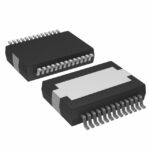 TDF8590TH/N1TJ
The activity of extra discounts on wholesale prices is in full swing…
Please fill in your contact information and we will send you the latest wholesale price list.






