 ChipApex | Global Electronic Components Supplier
SEARCH
Search Product
Search Post
— IC芯片 | 连接器 | 传感器 | 被动器件 —
Search productSearch post
— IC芯片 | 连接器 | 传感器 | 被动器件 —
Consult the customer manager about the wholesale price.
consultation hotline:86-132-6715-2157
email:[email protected]
Contact the product manager for consultation. One-stop consultation is available.
Do you want a lower wholesale price? Please send us your inquiry and we will reply immediately.
The TDF8591TH is a high-efficiency Class-D audio power amplifier designed for car audio systems. It features dual channels capable of delivering 2 × 100 W into 4 Ω in Single-Ended (SE) configuration, or 310 W into 4 Ω in Bridge-Tied Load (BTL) mode. The device operates on a supply voltage range from ±14 V to ±29 V and includes an internal heat sink within its HSOP24 package. It supports fixed gains of 26 dB in SE and 32 dB in BTL configurations.
Verify the specific ordering suffix against the manufacturer's current documentation to ensure compatibility with required packaging or environmental standards. Confirm that the HSOP24 package variant matches the thermal management requirements of the target application design.
Select this component for applications requiring high output power efficiency with minimal external heat sinking. Ensure the load impedance falls within the 2 Ω to 8 Ω range. Designers must account for the differential input requirement and implement appropriate RC networks on the MODE pin to manage startup pop noise.
This part belongs to NXP's portfolio of automotive-grade audio amplifiers. It utilizes Class-D technology to achieve high efficiency and low quiescent current. The device is AEC-Q100 qualified, ensuring reliability for automotive environments where wide temperature ranges and robust protection are critical.
Check for updated revisions of the TDF8591 series. Verify pinout compatibility if substituting with other NXP Class-D amplifiers. Ensure replacement parts support the same supply voltage range and thermal dissipation characteristics.
The frequency is set by an external resistor connected between the OSC pin and VSSA. An optimum setting is between 300 kHz and 350 kHz, typically achieved with a 30 kΩ resistor.
The OverTemperature Protection (OTP) circuit will immediately shut down the power stage to prevent damage.
Yes, depending on the supply voltage and load conditions, the small internal heat sink may allow operation without an external heat sink, though thermal resistance calculations are recommended.
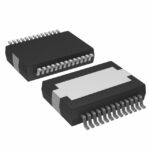 TDF8591TH/N1,118
The activity of extra discounts on wholesale prices is in full swing…
Please fill in your contact information and we will send you the latest wholesale price list.







