 ChipApex | Global Electronic Components Supplier
SEARCH
Search Product
Search Post
— IC芯片 | 连接器 | 传感器 | 被动器件 —
Search productSearch post
— IC芯片 | 连接器 | 传感器 | 被动器件 —
Consult the customer manager about the wholesale price.
consultation hotline:86-132-6715-2157
email:[email protected]
Contact the product manager for consultation. One-stop consultation is available.
Do you want a lower wholesale price? Please send us your inquiry and we will reply immediately.
The TDF8599BTH/N1CS is a dual Bridge-Tied Load (BTL) Class-D car audio amplifier manufactured by NXP USA Inc. It utilizes an NDMOST-NDMOST output stage based on SOI BCDMOS technology for high efficiency and low power dissipation. The device supports operation in either I2C-bus mode or non-I2C-bus mode, allowing for flexible system integration. It features differential inputs and operates within a supply voltage range of 8 V to 24 V. The amplifier provides two 4 Ω/2 Ω capable BTL channels or one 1 Ω capable BTL channel, with specific output power ratings defined under various load and voltage conditions.
Verify the exact part number TDF8599BTH/N1CS against the manufacturer's current ordering information to ensure availability and correct package type. Confirm that the HSOP36 package variant matches your PCB footprint requirements. Check for any specific environmental compliance certifications required for your region, such as RoHS status, as manufacturing processes may vary.
Select this component for applications requiring a high-efficiency Class-D amplifier with integrated diagnostics. Ensure the design accommodates the 36-HSOP package and provides adequate heat sinking given the power dissipation characteristics. Verify that the control interface (I2C or non-I2C) aligns with the system's microcontroller or logic capabilities. Consider the protection features when designing for automotive electrical environments.
The TDF8599B series belongs to NXP's portfolio of automotive audio amplifiers designed for connected radio and infotainment systems. These devices are qualified according to AEC-Q100 standards, ensuring reliability in automotive environments. The series includes variants like the TDF8599C and TDF8599ATH, offering different power outputs and packaging options while maintaining similar core functionalities and protection schemes.
Check NXP documentation for direct replacements or pin-compatible alternatives within the TDF8599 family, such as the TDF8599CTH/N1 or TDF8599ATH/N2. Verify that any substitute part meets the same voltage, power, and package specifications before implementation.
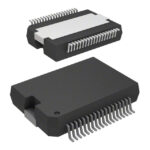 TDF8599BTH/N1CS
The activity of extra discounts on wholesale prices is in full swing…
Please fill in your contact information and we will send you the latest wholesale price list.





