 ChipApex | Global Electronic Components Supplier
SEARCH
Search Product
Search Post
— IC芯片 | 连接器 | 传感器 | 被动器件 —
Search productSearch post
— IC芯片 | 连接器 | 传感器 | 被动器件 —
Consult the customer manager about the wholesale price.
consultation hotline:86-132-6715-2157
email:[email protected]
Contact the product manager for consultation. One-stop consultation is available.
Do you want a lower wholesale price? Please send us your inquiry and we will reply immediately.
The TEA6880H is a monolithic bipolar integrated circuit designed as an up-level car radio analog signal processor (CASP). It integrates stereo decoding, ignition noise blanking, and tone/volume control for AM/FM applications. The device operates within a supply voltage range of 7.8 V to 9.2 V with a typical current consumption of 40 mA. Key electrical parameters include a stereo decoder signal-to-noise ratio of 78 dB and total harmonic distortion of 0.1%. Volume control ranges from +20 dB to -56 dB in 1 dB steps, while bass and treble controls offer ±18 dB and ±14 dB adjustment respectively. It features I²C-bus compatibility for digital alignment.
Verify the specific ordering suffix (e.g., /V2,518) against manufacturer documentation to confirm package type and tape/reel configuration. Confirm that the component meets automotive grade requirements if intended for vehicle integration. Check for obsolescence status as this series may be discontinued or superseded by newer models.
Select the TEA6880H for applications requiring integrated stereo decoding and noise blanking in a single package. Ensure the system design supports the required 7.8 V to 9.2 V supply voltage. Verify that the I²C-bus interface is compatible with the host microcontroller for digital control of tone, volume, and weak signal processing parameters.
The TEA6880H belongs to the Philips/NXP Semiconductors line of car radio ICs, often paired with demodulators like the TEA6840H. It serves as an analog signal processor handling stereo separation, noise reduction, and audio pre-amplification before final output stages.
Check for direct pin-compatible replacements within the NXP audio processor portfolio. Verify functional equivalence regarding I²C register maps and electrical characteristics if substituting with newer CASP devices.
Analog Step Interpolation (ASI) minimizes pops by smoothing audio transitions during switching. Audio Blend Control (ABC) automatically increments volume/loudness through each step between settings to further reduce audible artifacts.
The decoder uses a PLL to regenerate the 38 kHz subcarrier. An auxiliary PLL requires an external reference frequency of 75.4 kHz, typically provided by a companion demodulator chip like the TEA6840H via the FREF pin.
The selector supports six sources: two external stereo inputs (Channel A/B), one external symmetrical stereo input (Channel C), one external symmetrical mono input (Channel D), one internal stereo input (AM/FM), and one chime/diagnostic mono input.
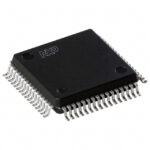 TEA6880H/V2,518
The activity of extra discounts on wholesale prices is in full swing…
Please fill in your contact information and we will send you the latest wholesale price list.





