 ChipApex | Global Electronic Components Supplier
SEARCH
Search Product
Search Post
— IC芯片 | 连接器 | 传感器 | 被动器件 —
Search productSearch post
— IC芯片 | 连接器 | 传感器 | 被动器件 —
Consult the customer manager about the wholesale price.
consultation hotline:86-132-6715-2157
email:[email protected]
Contact the product manager for consultation. One-stop consultation is available.
Do you want a lower wholesale price? Please send us your inquiry and we will reply immediately.
The TEF6892H is a monolithic BiMOS integrated circuit designed as a car radio signal processor. It integrates stereo decoding, weak signal processing, and ignition noise blanking for AM and FM bands. The device includes an input selector, tone/volume control, and RDS/RBDS demodulator/decoder functions. Operating with a supply voltage of 8 to 9 V, it features a Fast mode 400 kHz I²C-bus interface compatible with logic levels from 2.5 to 5 V. The component is housed in a QFP44 package (10x10 mm) and supports an operating temperature range of -40°C to +85°C.
Verify the specific ordering suffix against the manufacturer's current documentation to confirm package type and tape/reel specifications. Ensure compatibility with the system's I²C bus voltage levels, as the device interfaces with logic ranging from 2.5 to 5 V. Confirm that the 8 V to 9 V supply voltage requirement aligns with the vehicle's power architecture before integration.
Select this component for applications requiring high integration in automotive audio systems. It eliminates the need for external components except for coupling capacitors. Consider the available input sources: two external stereo inputs (CD, TAPE), one mono input (PHONE), and internal AM/FM signals. The Audio Step Interpolation (ASI) function is critical for minimizing pops during control transitions.
The TEF6892H belongs to the Philips Semiconductors (now NXP) family of car radio integrated circuits. It is often paired with TEA684x tuner ICs, which provide the necessary 75.4 kHz reference frequency for the stereo PLL and RDS demodulator. This combination allows for a complete radio solution with minimal external passive components.
Check for form, fit, and function compatibility if migrating from older versions or similar models in the TEF series. Verify that the replacement supports the required I²C bus speeds and voltage levels. Ensure the new part maintains the same pin configuration for the QFP44 package to avoid PCB redesign.
No, the RDS demodulator uses the reference frequency (75.4 kHz) provided by the tuner IC (e.g., TEA684x), eliminating the need for an external crystal.
The volume control ranges from +20 dB to -59 dB in 1 dB steps. Combined with the programmable loudness control (-20 dB), the overall control range is +20 dB to -79 dB.
It features fully integrated noise blankers for both bands. In FM mode, it operates as a sample and hold circuit, while in AM mode, it mutes the audio signal during interference pulses detected by a slew rate detector.
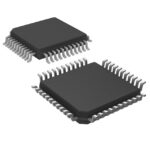 TEF6892H/V2,518
The activity of extra discounts on wholesale prices is in full swing…
Please fill in your contact information and we will send you the latest wholesale price list.







