 ChipApex | Global Electronic Components Supplier
SEARCH
Search Product
Search Post
— IC芯片 | 连接器 | 传感器 | 被动器件 —
Search productSearch post
— IC芯片 | 连接器 | 传感器 | 被动器件 —
Consult the customer manager about the wholesale price.
consultation hotline:86-132-6715-2157
email:[email protected]
Contact the product manager for consultation. One-stop consultation is available.
Do you want a lower wholesale price? Please send us your inquiry and we will reply immediately.
The TH7301EDF-TR is a dual-channel programmable low-pass filter incorporating two matching 4th-order Butterworth filters with voltage gain control. Designed for quadrature demodulated signals, it features a wide cutoff frequency range from 0.8 MHz to 22.4 MHz and in-band voltage gain adjustable between -3 dB and 20.5 dB. The device utilizes a standard 3-wire serial interface for programming. It includes an on-chip oscillator where the oscillation frequency tracks the filter cutoff frequency, allowing accurate setting verification. The IC operates from a negative supply (typically -5 V) and supports both single-ended and differential AC-coupled inputs.
Verify that the specific suffix 'EDF-TR' corresponds to the tape-and-reel packaging variant of the commercial grade TH7301C. Confirm the manufacturer origin, as Thesys was acquired by Melexis. Ensure the datasheet revision matches the component marking to avoid discrepancies in pinout or electrical characteristics.
Select this component when precise quadrature filtering is required for digital broadcast applications. The internal oscillator feature simplifies calibration compared to external reference methods. Verify that the system can accommodate the required negative power supply rails (-5V typical) and that the 3-wire serial interface timing meets the controller's capabilities.
The TH7301 is a specialized analog front-end IC originally manufactured by Thesys Gesellschaft für Mikroelektronik mbH. Following corporate acquisitions, the product line is now managed under Melexis Technologies NV. It serves as a dedicated solution for demodulation stages in communication receivers requiring matched I/Q filtering.
Direct replacements are not explicitly listed in the public documentation. Designers should evaluate other dual-channel programmable filters from Melexis or Thesys legacy portfolios, ensuring compatibility with the 16-pin SOP WB package and -5V supply requirements.
The device contains an on-chip oscillator that generates a frequency equal to the filter's -3dB cutoff point. This allows the actual cutoff frequency to be measured directly via the oscillator output.
The serial interface lacks a power-on reset. All three internal registers (Gain Control, Frequency Select A, and Frequency Select B) must be programmed after power-up to prevent undefined logical states.
Yes, while designed for a negative supply system, it can operate with positive supplies if the input signals are referred to the respective positive logic and analog supply rails.
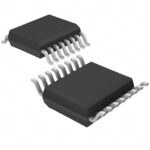 TH7301EDF-TR
The activity of extra discounts on wholesale prices is in full swing…
Please fill in your contact information and we will send you the latest wholesale price list.







