 ChipApex | Global Electronic Components Supplier
SEARCH
Search Product
Search Post
— IC芯片 | 连接器 | 传感器 | 被动器件 —
Search productSearch post
— IC芯片 | 连接器 | 传感器 | 被动器件 —
Consult the customer manager about the wholesale price.
consultation hotline:86-132-6715-2157
email:[email protected]
Contact the product manager for consultation. One-stop consultation is available.
Do you want a lower wholesale price? Please send us your inquiry and we will reply immediately.
The TLC5916IPWRG4 is an 8-bit constant-current LED sink driver manufactured by Texas Instruments. It operates within a supply voltage range of 3 V to 5.5 V and supports a maximum clock frequency of 30 MHz. The device provides eight independent output channels, each capable of sourcing up to 120 mA. It utilizes a serial interface for data input and is housed in a 16-pin TSSOP package. The component functions reliably across an extended temperature range from -40°C to +125°C.
Verify the specific ordering suffix G4 confirms RoHS compliance and lead-free material composition as per manufacturer standards. Ensure the TSSOP-16 package dimensions align with your PCB footprint requirements. Confirm that the 120 mA per channel rating meets your total power dissipation constraints within the operating temperature range. Cross-reference the datasheet revision to ensure compatibility with your design specifications.
Select this component when eight individually addressable constant-current sinks are required within a compact surface-mount package. It is suitable for designs needing integrated fault detection without external monitoring circuits. Consider the 30 MHz serial interface speed if high refresh rates are necessary. Evaluate thermal performance at maximum load conditions given the 125°C maximum junction temperature capability.
This part belongs to the TLC5916 series of 8-bit constant-current LED sink drivers from Texas Instruments. It shares functional similarities with other members like the TLC5916IDG4 but differs in packaging, specifically using the TSSOP form factor instead of SOIC. The series is designed for applications demanding reliable LED driving with diagnostic features in a small outline package.
The TLC5916IDG4 serves as a pin-compatible alternative offering identical electrical characteristics but packaged in a 16-SOIC (Narrow) format. Verify that the target PCB layout accommodates the SOIC footprint if substituting. Both parts share the same 8-channel constant-current functionality and fault detection features.
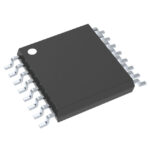 TLC5916IPWRG4
The activity of extra discounts on wholesale prices is in full swing…
Please fill in your contact information and we will send you the latest wholesale price list.





