 ChipApex | Global Electronic Components Supplier
SEARCH
Search Product
Search Post
— IC芯片 | 连接器 | 传感器 | 被动器件 —
Search productSearch post
— IC芯片 | 连接器 | 传感器 | 被动器件 —
Consult the customer manager about the wholesale price.
consultation hotline:86-132-6715-2157
email:[email protected]
Contact the product manager for consultation. One-stop consultation is available.
Do you want a lower wholesale price? Please send us your inquiry and we will reply immediately.
The TLE8261-2E is a Universal System Basis Chip (SBC) from the HERMES family, designed for automotive body controller and gateway applications. It integrates a high-speed CAN transceiver compliant with ISO 11898-2/5 and SAE J2284, supporting data rates up to 1 MBaud. The device provides three low-dropout voltage regulators: Vcc1µC (200 mA, 5 V ±2%), Vcc2 (200 mA, 5 V ±2%), and Vcc3 (up to 400 mA). Key features include a 16-bit SPI interface, configurable watchdog timers, Limp Home outputs, and multiple low-power modes including Sleep and Stop. It operates within an extended temperature range and is packaged in a PG-DSO-36-38 surface-mount case.
Verify that the specific orderable part number matches the required package variant (PG-DSO-36-38) and revision level. Confirm RoHS compliance status as per the latest manufacturer documentation. Ensure the supplier source is authorized to guarantee component authenticity and traceability for automotive-grade hardware.
Select the TLE8261-2E when no LIN transceivers are needed, distinguishing it from the TLE8262E/TLE8263E variants which include LIN cells. Ensure the application requires exactly three Limp Home outputs; if only one is needed, consider the non-suffixed 'E' versions. Verify that the external PNP transistor configuration for Vcc3 aligns with the shunt resistor requirements specified in the datasheet.
This component belongs to the scalable HERMES SBC family, sharing identical software functionality and core hardware features across models. The primary distinction of the TLE8261-2E is the absence of LIN transceivers, unlike the TLE8262E (1 LIN) and TLE8263E (2 LIN) counterparts. All family members maintain hardware compatibility for simplified platform design.
Direct pin-compatible replacements within the same package include other HERMES family members such as the TLE8262-2E or TLE8263-2E, provided the additional LIN interfaces are not utilized. Non-family alternatives require careful evaluation of pin mapping, regulator current capabilities, and CAN transceiver specifications.
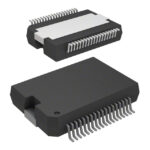 TLE8261-2E
The activity of extra discounts on wholesale prices is in full swing…
Please fill in your contact information and we will send you the latest wholesale price list.






