 ChipApex | Global Electronic Components Supplier
SEARCH
Search Product
Search Post
— IC芯片 | 连接器 | 传感器 | 被动器件 —
Search productSearch post
— IC芯片 | 连接器 | 传感器 | 被动器件 —
Consult the customer manager about the wholesale price.
consultation hotline:86-132-6715-2157
email:[email protected]
Contact the product manager for consultation. One-stop consultation is available.
Do you want a lower wholesale price? Please send us your inquiry and we will reply immediately.
The TLE94613ESXUMA1 is an automotive-grade System Basis Chip (SBC) from Infineon's OPTIREG Lite SBC family, housed in a PG-TSDSO-24-1 package. It integrates a high-speed CAN transceiver supporting FD communication up to 5 Mbit/s and CAN Partial Networking. The device provides two low-dropout linear voltage regulators: VCC1 at 5 V/150 mA for the microcontroller and VCC2 at 5 V/100 mA with short-to-battery protection. Key features include a configurable timeout/window watchdog, a charge pump output for reverse polarity protection, and extensive diagnostic capabilities via SPI.
Verify the specific ordering suffix against the manufacturer's datasheet to confirm pin compatibility and feature set. Ensure the component meets AEC-Q100 qualification requirements for the target automotive application environment.
Select this variant for applications requiring CAN FD support and partial networking functionality. Compare quiescent current specifications in Stop and Sleep modes against system power budget requirements. Confirm that the 150 mA regulator output is sufficient for the connected microcontroller load.
This component belongs to the scalable OPTIREG Lite SBC family. It shares hardware and software compatibility with other variants in the series, such as the TLE9461 and TLE9471, allowing for design flexibility across different product generations within the same package footprint.
Direct replacements within the same family include TLE9461ESV33XUMA1 and TLE9471-3ES. Verify that the alternative part number matches the required output voltage (5 V vs 3.3 V) and current ratings before substitution.
Yes, the integrated high-speed CAN transceiver supports CAN FD communication with data rates up to 5 Mbit/s.
The charge pump output is designed for N-channel MOSFET reverse polarity protection or can be used as a load switch feature with integrated spread spectrum modulation for EMC optimization.
It supports CAN Partial Networking according to ISO 11898-2:2016, enabling selective wake-up capabilities to reduce network traffic and power consumption.
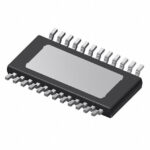 TLE94613ESXUMA1
The activity of extra discounts on wholesale prices is in full swing…
Please fill in your contact information and we will send you the latest wholesale price list.






