 ChipApex | Global Electronic Components Supplier
SEARCH
Search Product
Search Post
— IC芯片 | 连接器 | 传感器 | 被动器件 —
Search productSearch post
— IC芯片 | 连接器 | 传感器 | 被动器件 —
Consult the customer manager about the wholesale price.
consultation hotline:86-132-6715-2157
email:[email protected]
Contact the product manager for consultation. One-stop consultation is available.
Do you want a lower wholesale price? Please send us your inquiry and we will reply immediately.
The TLE9461ES is a monolithic System Basis Chip (SBC) from Infineon's Lite SBC family, designed for automotive CAN applications. It integrates a high-speed CAN transceiver supporting FD communication up to 5 Mbit/s, two low-dropout linear voltage regulators (LDOs), and a high-voltage GPIO with fail output capabilities. The device features a 16-bit SPI interface for control and monitoring, configurable watchdog circuits, and multiple wake-up sources including cyclic wake and bus activity. Packaged in a PG-TSDSO-24-1 exposed pad format, it operates within a wide temperature range of -40°C to +150°C and supports supply voltages up to 28V.
Verify the specific ordering suffix against the manufacturer's current datasheet to confirm package type and tape/reel specifications. Ensure compatibility with AEC-Q100 qualification requirements for automotive deployment. Confirm that the selected variant matches the required voltage regulator outputs and CAN transceiver speed for the target application design.
Select this component when a scalable system basis chip with integrated power management and CAN FD interface is required. The TLE9461ES provides software compatibility with other SBC families like TLE926x and TLE927x, facilitating design reuse. Consider the exposed pad package for thermal dissipation needs and verify that the 5V LDO outputs meet the microcontroller and sensor supply currents.
This part belongs to the OPTIREG Lite SBC family, which offers scalable solutions for automotive electronic control units. It shares the same PG-TSDSO-24-1 package footprint as other variants in the series, allowing for hardware compatibility across different feature sets. The family includes options for LIN interfaces and DCDC regulators, but the TLE9461ES specifically focuses on CAN FD with LDO regulation.
Direct replacements within the same family include TLE9461ESV33XUMA1 for 3.3V regulator variants or TLE9461-3ES for CAN Partial Networking versions. Verify pin-to-pin compatibility and register-level software compatibility before substitution to ensure seamless integration into existing designs.
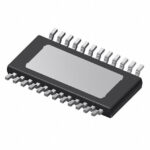 TLE9461ESXUMA1
The activity of extra discounts on wholesale prices is in full swing…
Please fill in your contact information and we will send you the latest wholesale price list.






