 ChipApex | Global Electronic Components Supplier
SEARCH
Search Product
Search Post
— IC芯片 | 连接器 | 传感器 | 被动器件 —
Search productSearch post
— IC芯片 | 连接器 | 传感器 | 被动器件 —
Consult the customer manager about the wholesale price.
consultation hotline:86-132-6715-2157
email:[email protected]
Contact the product manager for consultation. One-stop consultation is available.
Do you want a lower wholesale price? Please send us your inquiry and we will reply immediately.
The TLV2304IPWR is a quad nano-power operational amplifier and open-drain comparator integrated circuit manufactured by Texas Instruments. It operates on a single supply voltage ranging from 2.5 V to 16 V, with split supply operation supported between ±1.25 V and ±8 V. The device draws a typical supply current of 1.4 μA per channel (one op-amp and one comparator). Key electrical characteristics include a gain bandwidth product of 5.5 kHz, an input offset voltage of up to 4000 μV at 25°C, and a common-mode rejection ratio of 90 dB at 15 V. The package is TSSOP-14.
Verify the specific ordering suffix 'R' confirms the tape-and-reel packaging format as indicated in the datasheet options. Confirm the industrial temperature grade (-40°C to 125°C) matches system requirements. Ensure the TSSOP-14 package dimensions align with PCB layout constraints. Cross-reference the manufacturer part number TLV2304IDR or similar reel variants if exact suffix matching is required for inventory systems.
Select this component when both amplification and comparison functions are needed within a single footprint. The low supply current makes it suitable for energy-constrained designs. Consider the open-drain comparator output requirement for pull-up resistor implementation. Verify that the 5.5 kHz bandwidth meets signal frequency needs. Check compatibility with Li-Ion battery systems operating near 2.5 V.
The TLV2304 belongs to the TLV230x family of nano-power operational amplifiers and open-drain comparators. This series integrates sub-micropower performance with high input impedance. The quad configuration provides two operational amplifiers and two comparators per device, distinct from the dual-channel TLV2302 variant. The family emphasizes low power consumption while maintaining DC accuracy through low offset voltage specifications.
TLV2304ID: Same functional device but in SOIC-8 package instead of TSSOP-14. TLV2304IN: Same functional device but in PDIP-14 package instead of TSSOP-14. Verify pinout compatibility and thermal dissipation ratings when substituting packages.
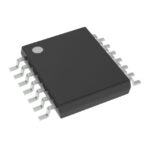 TLV2304IPWR
The activity of extra discounts on wholesale prices is in full swing…
Please fill in your contact information and we will send you the latest wholesale price list.







