 ChipApex | Global Electronic Components Supplier
SEARCH
Search Product
Search Post
— IC芯片 | 连接器 | 传感器 | 被动器件 —
Search productSearch post
— IC芯片 | 连接器 | 传感器 | 被动器件 —
Consult the customer manager about the wholesale price.
consultation hotline:86-132-6715-2157
email:[email protected]
Contact the product manager for consultation. One-stop consultation is available.
Do you want a lower wholesale price? Please send us your inquiry and we will reply immediately.
The TLV320AIC24CPFBRG4 is a low-power, highly integrated stereo audio codec featuring two 16-bit sigma-delta ADCs and two 16-bit DACs. It supports sampling rates up to 26 kSPS with on-chip FIR/IIR filters or 104 kSPS when bypassed. The device operates on analog supplies of 2.7 V to 3.6 V and digital core voltage of 1.65 V to 1.95 V. Key performance metrics include an SNR of 84 dB for the ADC and 92 dB for the DAC over a 13-kHz bandwidth. It utilizes a SMARTDM serial interface for DSP connectivity and includes programmable gain amplifiers, microphone bias, and multiple output drivers.
Verify the specific suffix 'RG4' against the manufacturer's current documentation to confirm lead times and availability status. Ensure the package type matches the design requirements. Confirm RoHS compliance details directly from the official datasheet before finalizing procurement plans.
Select this component for applications requiring low-power stereo voice-band conversion with integrated analog front-end capabilities. Verify that the required sampling rate and filter characteristics align with the system's signal processing needs. Ensure the host processor supports the SMARTDM or standard 4-wire serial interface protocols.
This part belongs to the TLV320AIC2x family of low-power audio codecs. It shares functional similarities with the TLV320AIC20, AIC21, AIC24, AIC25, AIC20K, and AIC24K models. The primary distinction lies in the operating temperature range and packaging configuration associated with the specific ordering suffixes.
Direct replacements within the same family include TLV320AIC20, TLV320AIC21, TLV320AIC24, TLV320AIC25, TLV320AIC20K, and TLV320AIC24K. Verify pin compatibility and electrical specifications before substitution.
The device supports a maximum master clock frequency of 100 MHz.
The SMARTDM interface allows for glueless connection to TI DSPs, supports automatic cascade detection, and enables up to eight devices to be connected to a single serial port.
Yes, the on-chip FIR and IIR filters can be bypassed to achieve higher sampling rates up to 104 kSPS.
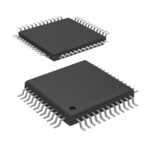 TLV320AIC24CPFBRG4
The activity of extra discounts on wholesale prices is in full swing…
Please fill in your contact information and we will send you the latest wholesale price list.






