 ChipApex | Global Electronic Components Supplier
SEARCH
Search Product
Search Post
— IC芯片 | 连接器 | 传感器 | 被动器件 —
Search productSearch post
— IC芯片 | 连接器 | 传感器 | 被动器件 —
Consult the customer manager about the wholesale price.
consultation hotline:86-132-6715-2157
email:[email protected]
Contact the product manager for consultation. One-stop consultation is available.
Do you want a lower wholesale price? Please send us your inquiry and we will reply immediately.
The TMUX1309QPWRQ1 is an automotive-grade, bidirectional 4:1, 2-channel CMOS multiplexer with injection current control. It operates on a single supply voltage ranging from 1.62 V to 5.5 V and supports rail-to-rail analog and digital signals. The device features internal injection current control, eliminating the need for external protection networks, and includes fail-safe logic to prevent damage during power sequencing. It is qualified under AEC-Q100 standards for Grade 1, ensuring reliable operation across an ambient temperature range of –40°C to +125°C.
Verify the specific ordering suffix 'PWR' corresponds to the 16-pin TSSOP package configuration required for your printed circuit board layout. Confirm that the component meets the AEC-Q100 Grade 1 qualification requirements for your target automotive environment. Ensure the design accommodates the specified thermal resistance metrics for the chosen package type to maintain junction temperatures within safe operating limits.
Select this component when a differential 4:1 multiplexing configuration is required in space-constrained automotive designs. The 16-pin TSSOP package offers a compact footprint suitable for high-density layouts. Consider the low off-state leakage and break-before-make switching characteristics if signal integrity and noise isolation are critical constraints in the system architecture.
This part belongs to the Texas Instruments TMUX13xx-Q1 family of general-purpose CMOS multiplexers. It serves as the two-channel counterpart to the single-channel TMUX1308-Q1. Both devices share identical pinouts and feature sets, allowing for flexible design choices between single-ended and differential signal routing within the same automotive platform without requiring layout modifications.
The TMUX1309QPWRQ1 is pin-compatible with industry standard 4052 and 4852 multiplexers. Designers replacing legacy discrete solutions or older CMOS ICs can utilize this component directly. Verify that the replacement maintains the required injection current handling capabilities and logic voltage thresholds for the existing control interface.
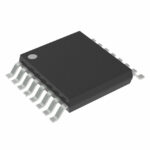 TMUX1309QPWRQ1
The activity of extra discounts on wholesale prices is in full swing…
Please fill in your contact information and we will send you the latest wholesale price list.





