 ChipApex | Global Electronic Components Supplier

SEARCH
Search Product
Search Post
Search productSearch post
Consult the customer manager about the wholesale price.
consultation hotline:86-132-6715-2157
email:[email protected]
Contact the product manager for consultation. One-stop consultation is available.
Do you want a lower wholesale price? Please send us your inquiry and we will reply immediately.
TNETE2201BPJW is listed in the Drivers, Receivers, Transceivers range at ChipApex. The manufacturer field lists Texas Instruments. Its product description is IC TRANSCEIVER HALF 1/1 64HTQFP. Review the specifications below when checking this part for your BOM.
The TNETE2201BPJW is a gigabit Ethernet transceiver designed for ultra high-speed bidirectional point-to-point data transmission. It operates at a typical rate of 1.25 Gbps, providing up to 1000 Mbps of bandwidth over copper or optical media interfaces. The device accepts 8b/10b parallel encoded data bytes and serializes them into differential nonreturn-to-zero (NRZ) signals at pseudo-ECL voltage levels. It features a 64-pin Quad Flat Pack with a thermally enhanced package and operates on a 3.3-V supply voltage with 5-V tolerant TTL inputs.
Verify the specific ordering suffix against official Texas Instruments documentation to confirm package type and temperature range. Confirm RoHS compliance status and moisture sensitivity level prior to integration. Ensure the component matches the exact datasheet revision required for your design specifications.
Select this component when designing systems requiring a dedicated SERDES solution for Gigabit Ethernet applications. Consider the 64-pin HTQFP package dimensions and thermal requirements during PCB layout. Verify that the system power supply meets the recommended operating conditions for VCC_A, VCC_CMOS, VCC_TX, and VCC_RX.
This device belongs to the TNETE2201B family of gigabit Ethernet transceivers manufactured by Texas Instruments. It is based on the timing requirements of the P802.3z specification. The BPJW suffix indicates a specific plastic quad flat pack variant with a thermally enhanced footprint designed for surface-mount assembly.
Consult the manufacturer's obsolescence notices for direct replacements. Cross-reference with other members of the TNETE2201B family if pin compatibility is required. Verify functional equivalence for any alternative SERDES components before implementation.
The TNETE2201B uses a 10-bit K28.5 character recognition scheme for word alignment. When SYNCEN is asserted high, the device examines serial input data to detect the K28.5 synchronization character and realigns data on byte boundaries if necessary.
The LOOPEN terminal enables the internal loop-back path for self-testing. When held high, transmitted serial data is routed directly to the receiver inputs, allowing protocol devices to perform functional verification while holding external differential outputs static.
The receiver generates two receive byte clocks, RBC0 and RBC1, which operate at 62.5 MHz. These clocks are 180 degrees out of phase and are used to synchronize the 10-bit output data on RD0 through RD9.
Explore related parts through Interface, Integrated Circuits (ICs), all product categories, ChipApex homepage.
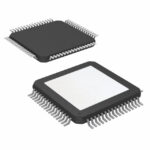 TNETE2201BPJW

The activity of extra discounts on wholesale prices is in full swing…
Please fill in your contact information and we will send you the latest wholesale price list.







