 ChipApex | Global Electronic Components Supplier
SEARCH
Search Product
Search Post
— IC芯片 | 连接器 | 传感器 | 被动器件 —
Search productSearch post
— IC芯片 | 连接器 | 传感器 | 被动器件 —
Consult the customer manager about the wholesale price.
consultation hotline:86-132-6715-2157
email:[email protected]
Contact the product manager for consultation. One-stop consultation is available.
Do you want a lower wholesale price? Please send us your inquiry and we will reply immediately.
The TPA0112PWP is a stereo audio power amplifier in a 24-pin thermally enhanced PowerPAD package. It delivers 2.6 W per channel into 3-ohm loads and operates with a supply voltage of 4.5 V to 5.5 V. The device features four selectable gain settings (2, 6, 12, and 24 V/V) via GAIN0 and GAIN1 pins, an internal input MUX for line or headphone sources, and integrated depop circuitry. It consumes 6 mA in normal operation and less than 150 µA in shutdown mode.
Verify the specific PWP package variant against the datasheet revision date. Confirm that the thermal pad soldering requirements are met in the PCB layout to ensure proper heat dissipation. Check for availability of the taped and reeled suffix 'R' if automated assembly is required. Ensure the supply voltage range matches the system's 5 V rail specifications.
Select this component when a compact stereo amplifier with low quiescent current is needed for single-supply applications. The internal MUX simplifies design by removing external switching components. Consider the input impedance variations across gain settings when designing coupling capacitors. The PowerPAD package requires careful thermal management on the PCB to achieve optimal performance.
This part belongs to Texas Instruments' family of Class-AB audio power amplifiers designed for portable and desktop audio applications. The TPA0112 specifically targets notebook and PC markets where board space is limited. It integrates functions typically requiring multiple discrete components, such as gain setting and input selection, to reduce overall system complexity.
No public confirmed substitute part numbers are available in the provided documentation.
Gain is set internally using the GAIN0 and GAIN1 digital input pins. In BTL mode, gains of 2, 6, 12, and 24 V/V are selectable. In SE mode, the gain is fixed at 1 V/V.
The SE/BTL pin controls the input multiplexer and output configuration. When held high, it selects headphone inputs (LHPIN/RHPIN) and Single-Ended mode. When held low, it selects line inputs (LLINEIN/RLINEIN) and Bridge-Tied Load mode.
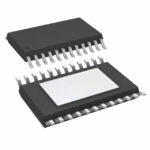 TPA0112PWP
The activity of extra discounts on wholesale prices is in full swing…
Please fill in your contact information and we will send you the latest wholesale price list.





