 ChipApex | Global Electronic Components Supplier
SEARCH
Search Product
Search Post
— IC芯片 | 连接器 | 传感器 | 被动器件 —
Search productSearch post
— IC芯片 | 连接器 | 传感器 | 被动器件 —
Consult the customer manager about the wholesale price.
consultation hotline:86-132-6715-2157
email:[email protected]
Contact the product manager for consultation. One-stop consultation is available.
Do you want a lower wholesale price? Please send us your inquiry and we will reply immediately.
The TPA2295CF-VS1R-S is a high-voltage, high-side current sense amplifier with an internal comparator and voltage reference. It features a gain of 50 V/V and operates from a single 3.0V to 18V supply. The device supports common-mode voltages from -0.1V to +70V with a typical CMRR of 130dB. It offers a bandwidth of 500kHz and a slew rate of 20 V/μs. The input offset voltage is ±500μV max over the temperature range. The package is MSOP-8.
Verify the specific suffix VS1R-S corresponds to the tape and reel packaging format containing 3,000 units per reel as documented in the order information table. Confirm that the CF designation strictly indicates the 50 V/V gain configuration for your circuit design requirements. Ensure compatibility with the MSOP-8 thermal characteristics during integration.
Select this component when high accuracy is required over wide temperature ranges due to its zero-drift architecture. The 50 V/V gain is suitable for applications requiring moderate amplification of small sense voltages. Consider the 70V common-mode limit and 18V supply constraint when designing the power stage. The integrated comparator simplifies designs needing immediate threshold detection without external components.
This part belongs to the TPA2295C family of high-voltage current sense amplifiers. Other variants in the family include TPA2295CT (20V/V), TPA2295CS (60V/V), TPA2295CH (100V/V), and TPA2295CW (200V/V). All share similar electrical characteristics but differ in output voltage scaling factors to accommodate various shunt resistor values and full-scale output requirements.
Direct substitutes are not explicitly listed in the provided documentation. Designers should evaluate other high-side current sense amplifiers offering similar 50V/V gain, 70V common-mode range, and MSOP-8 packaging if replacement is necessary.
The RESET pin is used to reset the internal comparator output. It is active low and requires a minimum pulse width of 0.2 μs to clear the latched state.
Yes, the input circuitry can accurately measure beyond its power-supply voltage (Vs). For example, Vs can be 5V while the load supply voltage is up to 70V, though the output swing is limited by Vs.
The zero-drift performance allows for lower full-scale drops across the sense resistor (e.g., ~10mV vs 100mV) while maintaining equivalent accuracy, which significantly reduces power dissipation in the shunt resistor.
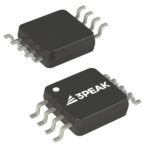 TPA2295CF-VS1R-S
The activity of extra discounts on wholesale prices is in full swing…
Please fill in your contact information and we will send you the latest wholesale price list.





