 ChipApex | Global Electronic Components Supplier
SEARCH
Search Product
Search Post
— IC芯片 | 连接器 | 传感器 | 被动器件 —
Search productSearch post
— IC芯片 | 连接器 | 传感器 | 被动器件 —
Consult the customer manager about the wholesale price.
consultation hotline:86-132-6715-2157
email:[email protected]
Contact the product manager for consultation. One-stop consultation is available.
Do you want a lower wholesale price? Please send us your inquiry and we will reply immediately.
The TPA9151-SO1R is a unity-gain difference amplifier designed for precision signal conditioning with a common voltage range of −275 V to +275 V. It operates on a supply voltage of 4.5 V to 36 V (±2.25 V to ±18 V) and features an offset voltage of ±1 mV maximum, gain error of 0.03% maximum, bandwidth of 500 kHz, and slew rate of 10 V/μs. The device includes EMI enhancement capabilities and functions within an operating temperature range of −40°C to 125°C.
Verify the specific suffix SO1R corresponds to the SOP-8 tape and reel packaging format containing 4000 units per reel as documented in the manufacturer's order information. Confirm that the component meets RoHS compatibility and halogen-free requirements specified under the Green designation. Ensure the ordering part number matches the exact pinout and reference pin configuration required for the target application design.
Select this component when high common-mode voltage handling up to 275 V is necessary without requiring galvanic isolation. The dual reference inputs distinguish it from the single-reference TPA9152 variant. Consider the 500 kHz bandwidth and 10 V/μs slew rate for dynamic signal processing needs. Verify that the power supply rails fall within the ±2.25 V to ±18 V operational limits for optimal performance.
The TPA9151 belongs to the 3PEAK family of general-purpose difference amplifiers. It shares the same package and thermal characteristics as the TPA9152 but differs in having two distinct reference input pins instead of one. Both devices utilize internal resistor trimming to maintain high CMRR and gain accuracy across the industrial temperature range.
The TPA9152-SO1R serves as a direct substitute if only a single reference input is required, as it internally ties REFA and REFB together. Other variants such as TPA9151A-SO1R and TPA9151B-SO1R offer specific CMRR enhancements for different common-mode voltage ranges.
The TPA9151 provides two separate reference input pins (REFA and REFB), whereas the TPA9152 has only one reference input pin with the second reference pin left unconnected (NC).
Yes, the datasheet states that the device can be used to replace isolation amplifiers in applications where galvanic isolation is not required.
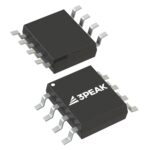 TPA9151-SO1R
The activity of extra discounts on wholesale prices is in full swing…
Please fill in your contact information and we will send you the latest wholesale price list.





