 ChipApex | Global Electronic Components Supplier
SEARCH
Search Product
Search Post
— IC芯片 | 连接器 | 传感器 | 被动器件 —
Search productSearch post
— IC芯片 | 连接器 | 传感器 | 被动器件 —
Consult the customer manager about the wholesale price.
consultation hotline:86-132-6715-2157
email:[email protected]
Contact the product manager for consultation. One-stop consultation is available.
Do you want a lower wholesale price? Please send us your inquiry and we will reply immediately.
The TPIC2810D is a monolithic, medium-voltage, low-current, 8-bit shift register designed to drive low-side switched resistive loads such as LEDs. It features an I2C interface for control and operates with a supply voltage range of 3 V to 5.5 V. The device provides an output voltage capability of 40 V and delivers a low-level output current of 100 mA per channel. It supports a maximum frequency of 2 MHz and functions within a junction temperature range of -40°C to 150°C. The component is housed in a 16-SOIC package.
Verify the specific suffix 'D' indicates the SOIC-16 package variant when ordering. Confirm that the design requires an I2C-compatible master controller. Ensure the application voltage does not exceed the 40 V output rating. Check that the operating temperature range meets the system's thermal requirements. Validate power supply stability within the 3 V to 5.5 V input range.
Select this component when an I2C-controlled, low-side LED driver is required. It is suitable for designs needing 8 independent channels with moderate current capabilities. Consider the 16-SOIC package for surface-mount assembly constraints. Evaluate the 40 V output voltage headroom against the load requirements. Ensure the system architecture supports the 2 MHz interface speed.
The TPIC2810D belongs to Texas Instruments' family of LED drivers and shift registers. It is part of the broader TPIC series, which offers various configurations for lighting control. The device serves as a bridge between digital controllers and analog loads, simplifying PCB layout by integrating level shifting and protection features into a single monolithic structure.
Publicly confirmed substitute part numbers are not available in the provided documentation. Verify compatibility with existing I2C bus protocols if considering alternative manufacturers. Ensure pinout and electrical characteristics match before substituting any other 8-bit shift register devices.
The TPIC2810D uses an I2C interface for data input and control.
The device supports an output voltage of up to 40 V.
No, it is designed specifically for low-side switched resistive loads.
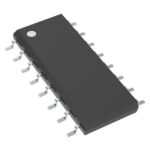 TPIC2810D
The activity of extra discounts on wholesale prices is in full swing…
Please fill in your contact information and we will send you the latest wholesale price list.





