 ChipApex | Global Electronic Components Supplier
SEARCH
Search Product
Search Post
— IC芯片 | 连接器 | 传感器 | 被动器件 —
Search productSearch post
— IC芯片 | 连接器 | 传感器 | 被动器件 —
Consult the customer manager about the wholesale price.
consultation hotline:86-132-6715-2157
email:[email protected]
Contact the product manager for consultation. One-stop consultation is available.
Do you want a lower wholesale price? Please send us your inquiry and we will reply immediately.
The TPIC6C596DG4 is an automotive-grade, high-voltage DMOS shift register manufactured by Texas Instruments. It features a serial-to-serial/parallel data path with registered parallel outputs and unregistered serial shift-right outputs. The device operates within a supply voltage range of 4.5 V to 5.5 V and supports propagation delays of up to 80 ns. Designed for robust performance, it functions across an extended temperature range from -40°C to +125°C. The component is housed in a 16-pin SOIC package and meets AEC-Q100 qualification standards for automotive applications.
Verify the specific suffix 'G4' indicates lead-free compliance and RoHS adherence as per Texas Instruments documentation. Confirm the package type matches the required PCB footprint. Ensure the operating environment stays within the specified -40°C to +125°C thermal limits. Validate that the 5.5 V maximum supply voltage aligns with the system power design. Check for any specific automotive quality certifications required by the end application.
Select this component when automotive qualification and high-voltage DMOS capabilities are required. It is suitable for applications needing registered parallel outputs to prevent glitching. Consider the 16-pin SOIC package for surface-mount assembly constraints. Evaluate the 80 ns propagation delay against system timing requirements. Ensure the 4.5 V to 5.5 V supply range matches the available power rail.
The TPIC6C596DG4 belongs to the TPIC6C596 series of high-voltage DMOS shift registers. This series is designed for driving inductive loads such as lamps and solenoids directly. The DG4 variant specifically denotes a lead-free, RoHS-compliant version in a small-outline integrated circuit package. It serves as a bridge between low-voltage logic controllers and high-power automotive or industrial loads.
Check for other TPIC6C596 variants with different suffixes (e.g., N, DR) if package changes are acceptable. Verify functional compatibility with similar high-voltage DMOS shift registers from other manufacturers. Ensure pinout and electrical characteristics match before substitution.
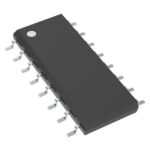 TPIC6C596DG4
The activity of extra discounts on wholesale prices is in full swing…
Please fill in your contact information and we will send you the latest wholesale price list.






