 ChipApex | Global Electronic Components Supplier
SEARCH
Search Product
Search Post
— IC芯片 | 连接器 | 传感器 | 被动器件 —
Search productSearch post
— IC芯片 | 连接器 | 传感器 | 被动器件 —
Consult the customer manager about the wholesale price.
consultation hotline:86-132-6715-2157
email:[email protected]
Contact the product manager for consultation. One-stop consultation is available.
Do you want a lower wholesale price? Please send us your inquiry and we will reply immediately.
The TPIC8101DWRG4 is a knock sensor interface integrated circuit manufactured by Texas Instruments, designed for automotive applications. It features a programmable gain amplifier and a programmable band-pass filter to condition signals from piezoelectric knock sensors. The device operates on a single 5 V supply with a maximum power dissipation of 100 mW. It supports serial communication via a 4-wire SPI interface and accepts differential or serial input voltages ranging from 50 mV to 5.2 V. The component functions within an operating temperature range of -40°C to +125°C and is housed in a 20-pin SOIC package.
Verify the specific ordering suffix G4 indicates RoHS compliance and lead-free construction as per Texas Instruments standards. Confirm that the DWR suffix corresponds to the SOIC-20 package and reel packaging format. Ensure compatibility with existing PCB footprints and verify that the AEC-Q100 qualification meets project requirements for automotive reliability.
Select this component when designing systems requiring dedicated hardware for knock sensor signal conditioning. It is suitable for applications needing adjustable gain and filtering without external discrete components. Consider the 20-SOIC package size for space-constrained designs. Verify that the 5 V logic levels align with the target microcontroller's I/O specifications.
The TPIC8101DWRG4 belongs to the TPIC8101 family of sensor interface devices. It serves as a specialized solution for automotive knock sensing, replacing complex discrete analog front-end designs. The G4 suffix denotes environmental compliance, while the DWR suffix specifies the surface-mount package type. This part integrates functionality typically requiring multiple external components into a single IC.
The TPIC8101DWR is listed as a similar replacement option. Verify pinout compatibility and electrical parameter equivalence before substitution. Ensure that any alternative component maintains the same SPI interface protocol and voltage levels.
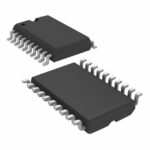 TPIC8101DWRG4
The activity of extra discounts on wholesale prices is in full swing…
Please fill in your contact information and we will send you the latest wholesale price list.





