 ChipApex | Global Electronic Components Supplier
SEARCH
Search Product
Search Post
— IC芯片 | 连接器 | 传感器 | 被动器件 —
Search productSearch post
— IC芯片 | 连接器 | 传感器 | 被动器件 —
Consult the customer manager about the wholesale price.
consultation hotline:86-132-6715-2157
email:[email protected]
Contact the product manager for consultation. One-stop consultation is available.
Do you want a lower wholesale price? Please send us your inquiry and we will reply immediately.
The TPW4425-QFKR-S is a four-channel single-pole dual-throw (SPDT) analog switch manufactured by 3PEAK. It operates on a supply voltage range of ±3.3V to ±8V or 3.3V to 16V, with an operating temperature range from –40°C to 125°C. The device features a typical ON-state resistance of 4.5Ω at Vs = ±5V and a bandwidth of 150 MHz. Switching times are specified as tON = 200ns and tOFF = 130ns at Vs = ±5V. It incorporates break-before-make switching action to prevent momentary shorting during channel transitions. The component is housed in a QFN-20 package.
Verify the specific ordering suffix 'QFKR' against the manufacturer's official documentation to confirm the QFN-20 package configuration and tape-and-reel quantity. Ensure that the selected variant matches the required thermal and electrical specifications for the intended application environment.
Select this component when designing multiplexer or demultiplexer circuits requiring high-speed switching and low power dissipation. Consider the 150 MHz bandwidth and fast switching times for applications demanding rapid signal path changes. Verify that the input signals remain within the supply voltage rails to ensure proper operation.
The TPW4425 is part of 3PEAK's general-purpose analog switch portfolio. It is designed using an enhanced process technology that balances low power consumption with high switching speeds. This family of devices serves as versatile building blocks for analog signal processing and routing tasks across various industrial and consumer electronics applications.
The datasheet lists the TSSOP-20 version (TPW4425-TS4R) as a future product option. No other direct cross-model replacements are documented in the provided materials.
The /E pin is an active-low digital input. When held high, it disables the device and turns off all switches. When held low, the INx logic inputs determine which switches are active.
In the QFN-20 package, the exposed pad is tied directly to the VEE pin, which represents the most negative power supply potential.
This feature prevents momentary shorting between channels during switching transitions, ensuring signal integrity and protecting connected circuitry.
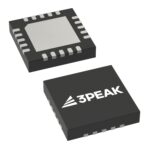 TPW4425-QFKR-S
The activity of extra discounts on wholesale prices is in full swing…
Please fill in your contact information and we will send you the latest wholesale price list.





