 ChipApex | Global Electronic Components Supplier
SEARCH
Search Product
Search Post
— IC芯片 | 连接器 | 传感器 | 被动器件 —
Search productSearch post
— IC芯片 | 连接器 | 传感器 | 被动器件 —
Consult the customer manager about the wholesale price.
consultation hotline:86-132-6715-2157
email:[email protected]
Contact the product manager for consultation. One-stop consultation is available.
Do you want a lower wholesale price? Please send us your inquiry and we will reply immediately.
The Visaton TR 10.16 is a step-down audio transformer designed for integration into 100-V constant-voltage speaker networks. It facilitates the connection of low-impedance speakers to high-voltage distribution lines, ensuring efficient long-distance audio transmission. The unit features a primary impedance of 1 kOhm and supports secondary loads of 4, 8, or 16 Ohms. Rated power handling reaches up to 10 W at 1 kOhm primary impedance. The frequency response spans from 50 Hz to 19 kHz, providing adequate bandwidth for voice and general audio applications in public address systems.
Verify that the specific order matches the Visaton TR 10.16 designation to ensure correct electrical characteristics. Confirm compatibility with existing 100-V infrastructure before installation. Check physical dimensions against available mounting space, as the unit requires chassis installation. Ensure power ratings align with the intended speaker load to prevent overload. Review technical specifications for frequency range limitations relative to application requirements.
Select this component when integrating standard low-impedance speakers into high-voltage distribution networks. It is suitable for applications requiring fixed impedance transformation without active signal processing. Consider the weight and external dimensions during mechanical design phases. Evaluate the frequency response limits to ensure suitability for the intended audio content type.
This component belongs to the Visaton audio transformer series, which includes various models for different power and impedance requirements. These transformers are engineered for reliable performance in professional audio environments. The TR 10.16 serves as a passive interface device, bridging the gap between amplifier output stages and speaker inputs in distributed sound systems.
Direct substitutes must match the 100-V primary specification and support 4, 8, or 16 Ohm secondary outputs. Verify equivalent power handling capabilities and frequency response ranges. Ensure physical mounting constraints are compatible with alternative components.
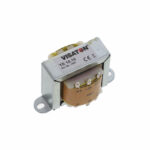 TR 10.16
The activity of extra discounts on wholesale prices is in full swing…
Please fill in your contact information and we will send you the latest wholesale price list.





