 ChipApex | Global Electronic Components Supplier
SEARCH
Search Product
Search Post
— IC芯片 | 连接器 | 传感器 | 被动器件 —
Search productSearch post
— IC芯片 | 连接器 | 传感器 | 被动器件 —
Consult the customer manager about the wholesale price.
consultation hotline:86-132-6715-2157
email:[email protected]
Contact the product manager for consultation. One-stop consultation is available.
Do you want a lower wholesale price? Please send us your inquiry and we will reply immediately.
The TSH344ID is a triple single-supply video buffer manufactured by STMicroelectronics. It features an internal gain of 6dB and a bandwidth of 340MHz. The device operates on a 3V to 5.5V supply, with typical performance tested at 5V. It guarantees a low output rail of 60mV max on a 150Ω load. Key electrical parameters include a slew rate of 740V/μs, input bias current of 16μA max, and supply current of 13mA per buffer. It is housed in an SO-8 package.
Verify the specific ordering suffix against the manufacturer's official documentation to confirm packaging type. The 'ID' suffix indicates tube packing, while 'IDT' denotes tape and reel. Confirm availability status as distribution channels may list obsolete or limited stock items. Ensure the component meets environmental compliance standards such as ECOPACK requirements before finalizing procurement decisions.
Select this component when driving RGB signals from video DACs without synchronization tips. It is suitable for applications requiring high linearity and low harmonic distortion. Consider the SO-8 package size for space-constrained designs. Verify that the system power supply falls within the 3V to 5.5V range and that the load impedance matches the specified 100Ω or 150Ω conditions for optimal performance.
The TSH344 belongs to the TSH34x series of single-supply video buffers. It is designed specifically for driving RGB components on video lines. Unlike the TSH343, which handles Y-Pb-Pr signals with synchronization tips, the TSH344 is optimized for digital synchronization scenarios. It shares similar architectural benefits with other members of the family but focuses on RGB output buffering.
The TSH343 is a related component for Y-Pb-Pr signals. No direct public substitute part numbers are confirmed in the provided datasheet. Designers should verify pin compatibility and electrical specifications if considering alternative vendors or newer generations from the same manufacturer.
The low-level output voltage is guaranteed to be a maximum of 60mV when tested on a 150Ω load.
No, it is designed for single-supply operation and does not use AC output coupling capacitors due to its inability to sink output current.
The delay between each channel is minimal, typically less than 0.5ns, ensuring synchronized video outputs.
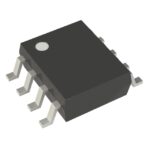 TSH344ID
The activity of extra discounts on wholesale prices is in full swing…
Please fill in your contact information and we will send you the latest wholesale price list.






