 ChipApex | Global Electronic Components Supplier
SEARCH
Search Product
Search Post
— IC芯片 | 连接器 | 传感器 | 被动器件 —
Search productSearch post
— IC芯片 | 连接器 | 传感器 | 被动器件 —
Consult the customer manager about the wholesale price.
consultation hotline:86-132-6715-2157
email:[email protected]
Contact the product manager for consultation. One-stop consultation is available.
Do you want a lower wholesale price? Please send us your inquiry and we will reply immediately.
The Tamura TTC-5014 is a telecommunications audio transformer designed for modem and voice line applications. It features a 600-ohm primary impedance and a 348-ohm secondary impedance, providing a 1:1 turns ratio. The component utilizes through-hole mounting with four terminals and PC pins for secure PCB integration. Electrical specifications include a primary DC resistance of 152 ohms and a secondary DC resistance of 151 ohms. It supports an operating frequency range from 200 Hz to 4 kHz with a typical insertion loss of 3.25 dB. The unit is rated for 1500 Vrms isolation voltage.
Verify the specific datasheet version to confirm mechanical dimensions and pinout configurations before finalizing the design. Ensure that the supplier provides original manufacturer documentation to validate compliance with RoHS standards and material safety data sheets. Cross-reference the part number with authorized distributors to confirm current availability status and lead times.
Select this component when a 600-ohm to 348-ohm impedance transformation is required for analog signal integrity in telecom systems. Consider the 1500 Vrms isolation rating for safety requirements. Evaluate the physical footprint constraints against the through-hole package dimensions to ensure compatibility with the target printed circuit board layout and manufacturing processes.
This component belongs to Tamura's portfolio of audio and signal transformers, specifically engineered for telecommunication infrastructure. These devices are critical for maintaining signal quality and electrical safety in legacy and modern telephone networks. The series typically includes variants with different impedance ratios to accommodate various international line standards.
Consult official substitution lists or equivalent product catalogs from Tamura and other manufacturers. Verify that any alternative part matches the 600/348 ohm impedance ratio, 1:1 turns ratio, and 1500 Vrms isolation rating. Confirm mechanical compatibility regarding terminal count and through-hole spacing.
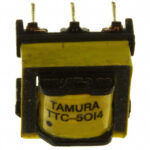 TTC-5014
The activity of extra discounts on wholesale prices is in full swing…
Please fill in your contact information and we will send you the latest wholesale price list.





