 ChipApex | Global Electronic Components Supplier
SEARCH
Search Product
Search Post
— IC芯片 | 连接器 | 传感器 | 被动器件 —
Search productSearch post
— IC芯片 | 连接器 | 传感器 | 被动器件 —
Consult the customer manager about the wholesale price.
consultation hotline:86-132-6715-2157
email:[email protected]
Contact the product manager for consultation. One-stop consultation is available.
Do you want a lower wholesale price? Please send us your inquiry and we will reply immediately.
The TWL1107PWR is a voice-band audio processor (VBAP) designed for analog and digital wireless handsets. It performs transmit A/D conversion, receive D/A conversion, and filtering within a 300-Hz to 3.4-kHz passband. Operating on a 2.7-V to 3.3-V supply, it supports selectable 13-bit linear or 8-bit A-law companded modes. The device features a differential microphone input with external gain setting and a differential earphone output capable of driving loads from 8 Ω to 32 Ω. It generates internal clocks from a 2.048-MHz master clock input and includes programmable volume control in linear mode.
Verify the specific package variant against the datasheet. The TWL1107PWR indicates a PW (TSSOP) package. Confirm that the ordering suffix matches the required tape-and-reel or bulk configuration if applicable, as packaging options may vary by manufacturer lot. Ensure the component meets the -40°C to 85°C operating temperature range specified for this part number.
Select the TWL1107PWR when a dedicated voice-band processor is required for wireless handset designs. Choose the linear mode for higher fidelity requirements using 13-bit resolution, or the A-law mode for standard telephony compatibility using 8-bit companding. Ensure the system provides a stable 2.048-MHz master clock and that the power supply remains within the 2.7-V to 3.3-V range for optimal performance.
The TWL1107 belongs to Texas Instruments' VBAP family, specialized for voice-band communications. It integrates transmit and receive filters meeting CCITT G.714 standards. The device simplifies design by generating internal clocks from a single master clock input and combining analog front-end amplification with digital modulation and demodulation in a single low-profile package.
Public confirmed substitute part numbers are not available in the provided documentation. Verify pin-to-pin compatibility and electrical specifications with alternative voice-band processors before substitution.
The microphone gain is set externally using resistors connected to the MICGAIN+ and MICGAIN– terminals. For a recommended gain of 23.5 dB, use R2 = 34 kΩ and R3 = 510 kΩ.
The sampling rate is fixed at 8 kHz, determined by the PCMSYN signal which must be derived from the 2.048-MHz master clock with a divide ratio of 256.
In linear mode, the three least significant bits (RXVOL) of the 16-bit PCMI data sample control the volume in 3-dB steps from -18 dB to +3 dB. Volume control is fixed at 0 dB in companded mode.
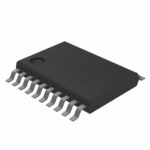 TWL1107PWR
The activity of extra discounts on wholesale prices is in full swing…
Please fill in your contact information and we will send you the latest wholesale price list.





