 ChipApex | Global Electronic Components Supplier
SEARCH
Search Product
Search Post
— IC芯片 | 连接器 | 传感器 | 被动器件 —
Search productSearch post
— IC芯片 | 连接器 | 传感器 | 被动器件 —
Consult the customer manager about the wholesale price.
consultation hotline:86-132-6715-2157
email:[email protected]
Contact the product manager for consultation. One-stop consultation is available.
Do you want a lower wholesale price? Please send us your inquiry and we will reply immediately.
The UA733CNSR is a monolithic two-stage video amplifier manufactured by Texas Instruments, housed in a 14-pin SOP (NS) package. It features differential inputs and outputs with selectable nominal amplification of 10 V/V, 100 V/V, or 400 V/V. The device provides a bandwidth of up to 200 MHz and an input resistance of 250 kΩ at the highest gain setting. It operates within a temperature range of 0°C to 70°C and requires no external frequency compensation components.
Verify the specific ordering suffix 'SR' corresponds to the tape-and-reel packaging format as documented in the manufacturer's official Package Option Addendum. Confirm that the SOP (NS) package designation aligns with your printed circuit board layout requirements. Ensure the commercial temperature range specification meets your operational environmental constraints before finalizing procurement.
Select this component when differential signal processing with high bandwidth is required. The UA733CNSR is suitable for applications needing adjustable gain without external compensation networks. Consider the 14-pin SOP package dimensions for space-constrained designs. Evaluate the supply current and power dissipation characteristics against your thermal management capabilities.
This part belongs to the µA733 family of differential video amplifiers. The 'C' suffix indicates the commercial temperature grade (0°C to 70°C), while the 'NS' suffix denotes the Small Outline Package. The 'SR' suffix specifies the reel packaging quantity. This family is designed for high-speed analog signal processing tasks.
Public confirmed substitute part numbers are not available in the provided documentation. Verify compatibility with existing designs if considering alternative manufacturers, as pinouts and electrical characteristics may differ significantly.
Gain can be set to fixed values of 10, 100, or 400 V/V by connecting specific gain-adjust pins. Alternatively, continuous adjustment from 10 V/V to 400 V/V is achieved by placing a single external resistor between pins 1A and 1B.
No, the device does not require external frequency-compensating components for any gain option due to its internal series-shunt feedback design.
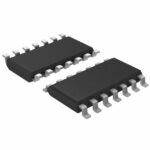 UA733CNSR
The activity of extra discounts on wholesale prices is in full swing…
Please fill in your contact information and we will send you the latest wholesale price list.





