 ChipApex | Global Electronic Components Supplier
SEARCH
Search Product
Search Post
— IC芯片 | 连接器 | 传感器 | 被动器件 —
Search productSearch post
— IC芯片 | 连接器 | 传感器 | 被动器件 —
Consult the customer manager about the wholesale price.
consultation hotline:86-132-6715-2157
email:[email protected]
Contact the product manager for consultation. One-stop consultation is available.
Do you want a lower wholesale price? Please send us your inquiry and we will reply immediately.
The UCC28060D is a single-chip interleaved power factor correction (PFC) controller from Texas Instruments, designed for multi-kilowatt communications, server, and industrial systems. It implements two-phase average current-mode control to simplify power design and enhance system reliability. The device achieves a power factor rating greater than 0.9, improving energy efficiency through advanced current synthesis and accurate sensing. Key electrical specifications include a programmable switching frequency range of 30 kHz to 300 kHz and selectable frequency dithering for reduced electromagnetic interference (EMI). It features highly linear multiplier output with internal voltage feed-forward correction for near-unity power factor operation.
Verify the specific suffix 'D' corresponds to the SOIC-20 package variant when sourcing. Confirm that the component matches the official Texas Instruments datasheet parameters for the UCC28060 series. Ensure compatibility with interleaved PFC designs requiring two-phase control. Cross-reference ordering information with authorized distributors to guarantee authenticity and traceability.
Select this controller for applications requiring high-efficiency power factor correction in multi-kilowatt ranges. The interleaved architecture reduces input and output ripple currents compared to single-phase solutions. Consider the programmable frequency range for optimizing magnetic component size and EMI performance. Ensure the design supports the necessary thermal management for industrial or server environments.
The UCC28060D belongs to the UCC28060/UCC28070 family of interleaved PFC controllers. These devices are engineered to provide robust power factor correction for high-power density applications. The family utilizes average current-mode control to deliver precise regulation and improved dynamic response across varying load conditions.
The UCC28060D utilizes two-phase average current-mode control for interleaved power factor correction.
It provides selectable frequency dithering to reduce electromagnetic interference (EMI) emissions.
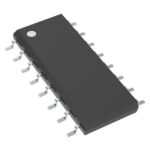 UCC28060D
The activity of extra discounts on wholesale prices is in full swing…
Please fill in your contact information and we will send you the latest wholesale price list.





