 ChipApex | Global Electronic Components Supplier
SEARCH
Search Product
Search Post
— IC芯片 | 连接器 | 传感器 | 被动器件 —
Search productSearch post
— IC芯片 | 连接器 | 传感器 | 被动器件 —
Consult the customer manager about the wholesale price.
consultation hotline:86-132-6715-2157
email:[email protected]
Contact the product manager for consultation. One-stop consultation is available.
Do you want a lower wholesale price? Please send us your inquiry and we will reply immediately.
The UCC5630AMWP is a multimode SCSI terminator designed for LVD and SE bus architectures. It operates within a TRMPWR range of 2.7V to 5.25V. The device provides differential termination with an impedance of 100Ω to 110Ω and single-ended termination at 102.3Ω to 117.7Ω. Supply current varies by mode: 13mA to 20mA in LVD, 1.6mA to 10mA in SE, and 250µA to 400µA when disabled. REG output voltage is 1.15V to 1.35V (LVD) or 2.5V to 3.0V (SE). Output capacitance is 3pF per line. It supports SPI-2 through SPI-4 standards.
Verify the specific package variant against the datasheet options. The UCC5630AMWP corresponds to the 36-pin SSOP package. Confirm that the ordering suffix matches the desired reel quantity and lead-free status, as standard and tape/reel versions exist. Ensure the design accounts for the 0°C to 70°C operating temperature range specified for this part number.
Select this component for SCSI applications requiring simultaneous support for legacy SE and modern LVD devices. The integrated auto-detection eliminates the need for manual jumper configuration. Ensure the PCB layout adheres to the strict capacitance balance requirements (0.75pF max difference within pairs) to maintain signal integrity at high data rates.
This device belongs to the UCC5630 family of multimode SCSI terminators. While the base UCC5630A covers the functional specifications, the AMWP suffix specifically denotes the 36-pin Shrink Small Outline Package (SSOP). Other variants include the 48-pin LQFP package for higher pin count implementations.
The UCC5630AFQP serves as a direct functional replacement offering the same electrical characteristics but housed in a 48-pin LQFP package. Verify pinout compatibility and thermal management requirements when substituting the SSOP package for the LQFP package or vice versa.
It monitors the voltage on the DIFSENS pin via the DIFFB input. If the voltage is below 0.5V, it selects SE mode; between 0.7V and 1.9V, it selects LVD mode; and above 2.4V, it enters a high-impedance state for HVD detection.
The MSTR/SLV pin controls the DIFSENS driver. In a system using three chips to terminate 27 lines, one master chip drives the DIFSENS line while the two slave chips disable their drivers to prevent contention.
No. If an HVD device is detected, the UCC5630AMWP automatically switches to a high-impedance state to disconnect from the bus, preventing damage or interference.
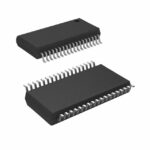 UCC5630AMWP
The activity of extra discounts on wholesale prices is in full swing…
Please fill in your contact information and we will send you the latest wholesale price list.





