 ChipApex | Global Electronic Components Supplier
SEARCH
Search Product
Search Post
— IC芯片 | 连接器 | 传感器 | 被动器件 —
Search productSearch post
— IC芯片 | 连接器 | 传感器 | 被动器件 —
Consult the customer manager about the wholesale price.
consultation hotline:86-132-6715-2157
email:[email protected]
Contact the product manager for consultation. One-stop consultation is available.
Do you want a lower wholesale price? Please send us your inquiry and we will reply immediately.
The UCD3138RGCR is a highly integrated digital power controller from Texas Instruments, designed for AC/DC and isolated DC/DC applications. It features three independent Fusion Digital Power Peripherals (FDPP), each comprising an Error ADC, a PID-based 2-pole/2-zero compensator, and DPWM outputs with 250 ps resolution. The device integrates a 32-bit ARM7TDMI-S microcontroller, a 12-bit general-purpose ADC with up to 14 channels, and communication interfaces including PMBus and UART. Operating within a supply voltage range of 3 V to 3.6 V, it supports various topologies such as LLC, phase-shifted full bridge, and PFC.
Verify the specific package variant, as RGCR denotes a TQFP-80 package. Confirm RoHS compliance status through official datasheets. Ensure firmware compatibility with Code Composer Studio or Fusion Power Development GUI tools. Check for moisture sensitivity classification requirements during storage and handling. Validate pinout configurations against schematic designs prior to integration.
Select this component when designing systems requiring multi-loop digital control with high flexibility. Consider its suitability for complex topologies like phase-shifted full bridge or LLC resonant converters. Evaluate the need for its integrated general-purpose ADC and communication interfaces. Assess if the ARM7TDMI-S core performance meets real-time processing demands. Compare against other UCD3138 variants based on package size and pin count requirements.
The UCD3138 series represents Texas Instruments' approach to highly integrated digital power management. It combines traditional analog control functions with digital programmability via an embedded microcontroller. This architecture allows for adaptive control strategies and reduced external component counts in power conversion designs.
Check for UCD3138RGCT or UCD3138ARMHT as alternative packages within the same family. Verify functional equivalence regarding FDPP capabilities and microcontroller specifications. Ensure pin-to-pin compatibility if direct replacement is required without PCB redesign.
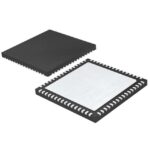 UCD3138RGCR
The activity of extra discounts on wholesale prices is in full swing…
Please fill in your contact information and we will send you the latest wholesale price list.





