 ChipApex | Global Electronic Components Supplier
SEARCH
Search Product
Search Post
— IC芯片 | 连接器 | 传感器 | 被动器件 —
Search productSearch post
— IC芯片 | 连接器 | 传感器 | 被动器件 —
Consult the customer manager about the wholesale price.
consultation hotline:86-132-6715-2157
email:[email protected]
Contact the product manager for consultation. One-stop consultation is available.
Do you want a lower wholesale price? Please send us your inquiry and we will reply immediately.
The UDA1355H is a stereo audio codec with an SPDIF interface, operating on a 2.7 to 3.6 V power supply. It integrates a digital interpolator filter and DAC alongside an ADC, PGA, and decimator filter, both featuring 24-bit data paths. The device supports IEC 60958 input and output, accepting level I, II, and III timing for inputs and generating full-swing CMOS outputs. It accommodates sampling frequencies from 16 to 100 kHz via the digital I/O interface and utilizes a 12.288 MHz crystal oscillator with a low jitter PLL for clock generation. Control is achieved through static pins or microcontroller interfaces (L3-bus or I2C-bus).
Verify component authenticity by checking the marking code against official NXP documentation. Confirm package type QFP44 and lead length specifications. Ensure compliance with RoHS and halogen-free requirements as indicated in material declarations. Check for end-of-life status and availability of alternative sources if necessary.
Select this component for applications requiring a single-chip solution for stereo audio conversion with SPDIF connectivity. Consider the 2.7 to 3.6 V supply range and the need for a 12.288 MHz external crystal. Evaluate control interface preferences between static pins and microcontroller buses based on system complexity.
The UDA1355H belongs to NXP's line of integrated audio codecs designed for high-quality audio processing. It combines analog front-end capabilities with digital signal processing features, targeting applications that demand precise audio handling and flexible interface options within a compact QFP44 package.
No public confirmed substitute part numbers are available in the provided documentation. Verify compatibility with existing circuit designs if considering alternatives, focusing on pinout and functional equivalence.
A 12.288 MHz crystal is required for the crystal oscillator and PLL circuit to generate standard audio sampling frequencies.
The UDA1355H supports one of four selectable SPDIF input channels.
Yes, it can operate in static mode using control pins, although microcontroller mode offers full feature access.
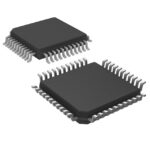 UDA1355H/N2,557
The activity of extra discounts on wholesale prices is in full swing…
Please fill in your contact information and we will send you the latest wholesale price list.






