 ChipApex | Global Electronic Components Supplier
SEARCH
Search Product
Search Post
— IC芯片 | 连接器 | 传感器 | 被动器件 —
Search productSearch post
— IC芯片 | 连接器 | 传感器 | 被动器件 —
Consult the customer manager about the wholesale price.
consultation hotline:86-132-6715-2157
email:[email protected]
Contact the product manager for consultation. One-stop consultation is available.
Do you want a lower wholesale price? Please send us your inquiry and we will reply immediately.
The UDA1380TT/N2,512 is a stereo audio coder-decoder designed for Mini-Disc, CD, and MP3 applications. It operates on a 2.4 to 3.6 V power supply with 5 V tolerant digital inputs. The device features a 24-bit data path for both ADC and DAC functions. The ADC supports sample frequencies from 8 to 55 kHz, while the DAC supports 8 to 100 kHz. It includes a stereo line input with PGA (0 to 24 dB gain) and a mono microphone input with LNA (29 dB fixed gain) and VGA (0 to 30 dB). The DAC provides separate single-ended line outputs and a stereo headphone driver capable of driving a 16 Ω load. Control is managed via L3-bus or I2C-bus interfaces.
Verify the specific ordering suffix N2,512 against current NXP documentation to confirm package type and environmental compliance status. Ensure the design accounts for the device's default power-down state upon initialization. Confirm interface compatibility with the host controller's L3-bus or I2C-bus implementation before finalizing the bill of materials.
Select this component when designing portable audio systems requiring high integration of analog and digital audio processing. The dual-clock capability allows asynchronous operation between recording and playback paths. Consider the available gain ranges of the PGA and VGA to match specific microphone and line-level input requirements without external amplification stages.
The UDA1380TT variant utilizes a TSSOP32 plastic thin shrink small outline package with 32 leads and a body width of 6.1 mm. This package version offers identical functional specifications to the HVQFN32 variant. The TT designation specifically identifies the leaded surface-mount package configuration within the broader UDA1380 product family.
No direct public substitute part numbers are documented in the provided datasheet. Designers should evaluate newer NXP audio codec families for modern replacements, ensuring pin compatibility and feature parity if a drop-in replacement is required.
Yes, the ADC and DAC parts can run at different frequencies. One can operate on the system clock while the other uses the Word Select PLL, or both can use different clock sources simultaneously.
The microphone input features a Low Noise Amplifier with 29 dB fixed gain and a Variable Gain Amplifier providing an additional 0 to 30 dB gain in steps of 2 dB.
No, the headphone driver can be connected directly to the VREF(HP) pin, allowing it to drive headphones without the need for external DC decoupling capacitors.
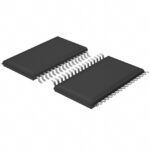 UDA1380TT/N2,512
The activity of extra discounts on wholesale prices is in full swing…
Please fill in your contact information and we will send you the latest wholesale price list.





