 ChipApex | Global Electronic Components Supplier
SEARCH
Search Product
Search Post
— IC芯片 | 连接器 | 传感器 | 被动器件 —
Search productSearch post
— IC芯片 | 连接器 | 传感器 | 被动器件 —
Consult the customer manager about the wholesale price.
consultation hotline:86-132-6715-2157
email:[email protected]
Contact the product manager for consultation. One-stop consultation is available.
Do you want a lower wholesale price? Please send us your inquiry and we will reply immediately.
The ULN2004AIDR is a high-voltage, high-current Darlington transistor array manufactured by Texas Instruments. It consists of seven NPN Darlington pairs with common emitters and integrated clamp diodes for switching inductive loads. Each channel supports a collector current of 500 mA and withstands up to 50 V. The device features a 10.5-kΩ series base resistor per pair, enabling direct interface with TTL or 5-V CMOS logic. Packaged in a 16-pin SOIC (D) format, it operates within a temperature range of -40°C to 105°C.
Verify the active status and RoHS compliance through official Texas Instruments documentation before procurement. Confirm that the SOIC-16 package dimensions and thermal characteristics align with the target PCB layout requirements. Ensure the operating temperature range meets the specific environmental conditions of the intended application.
Select this component when driving inductive loads such as relays or solenoids directly from low-voltage logic sources. The internal base resistors simplify circuit design by eliminating external components. Consider parallel connection of outputs if higher single-channel current capacity than 500 mA is required.
This part belongs to the ULx200xA family of high-voltage Darlington arrays. While other variants like ULN2003A are optimized for 5-V TTL/CMOS and ULN2002A for PMOS, the ULN2004A variant specifically targets applications requiring operation with 6-V to 15-V CMOS or PMOS devices due to its unique base resistance values.
ULN2004AID: Identical electrical specifications and functionality; differs only in tube packaging instead of tape-and-reel.
The common-cathode clamp diodes protect the Darlington transistors from voltage spikes generated by inductive loads during switching.
The ULN2004A includes a 10.5-kΩ base resistor suitable for 6-V to 15-V CMOS/PMOS, whereas the ULN2003A uses a 2.7-kΩ resistor designed for 5-V TTL/CMOS.
Yes, the device contains seven independent channels that can operate concurrently or be paralleled to increase total current capability.
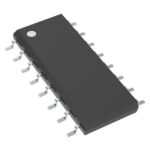 ULN2004AIDR
The activity of extra discounts on wholesale prices is in full swing…
Please fill in your contact information and we will send you the latest wholesale price list.




