 ChipApex | Global Electronic Components Supplier
SEARCH
Search Product
Search Post
— IC芯片 | 连接器 | 传感器 | 被动器件 —
Search productSearch post
— IC芯片 | 连接器 | 传感器 | 被动器件 —
Consult the customer manager about the wholesale price.
consultation hotline:86-132-6715-2157
email:[email protected]
Contact the product manager for consultation. One-stop consultation is available.
Do you want a lower wholesale price? Please send us your inquiry and we will reply immediately.
The UMC5N-7 is a dual complementary pre-biased transistor array manufactured by Diodes Incorporated, housed in an SOT353 surface-mount package. It integrates one NPN and one PNP bipolar junction transistor with internal biasing resistors to simplify circuit design. The NPN transistor (Q1) features a maximum collector current of 100 mA, a supply voltage rating of 50 V, and a typical input resistance of 47 kΩ. The PNP transistor (Q2) also supports a 100 mA collector current with a -50 V supply rating and a typical input resistance of 4.7 kΩ. Both transistors exhibit a gain-bandwidth product of 250 MHz and a maximum power dissipation of 150 mW at 25°C ambient temperature.
Verify the specific ordering suffix against manufacturer documentation to confirm packaging details, as standard quantities may vary. Confirm RoHS compliance status and halogen-free classification requirements prior to procurement. Ensure that the selected variant matches the required thermal and electrical specifications for the intended operating environment.
Select this component when a compact solution for complementary switching is required within a single package. Evaluate the 150 mW power dissipation limit relative to the expected thermal conditions on the PCB. Consider the 47 kΩ and 4.7 kΩ base resistor values to determine compatibility with the driving logic levels and required switching speeds.
This device belongs to the UMC5 series of dual complementary pre-biased transistors produced by Diodes Incorporated. The series is designed to replace multiple discrete components, offering a simplified alternative for designs needing both NPN and PNP switching capabilities in a minimal footprint.
Check for direct equivalents such as the UMC5NQ-7 or UMC5NTR from other manufacturers if pinout and electrical parameters match. Verify that any substitute maintains the same SOT353 package dimensions and AEC-Q101 qualification if automotive reliability is required.
The NPN transistor (Q1) has a typical input resistance (R1) of 47 kΩ, while the PNP transistor (Q2) has a typical input resistance (R1) of 4.7 kΩ.
Yes, the device is qualified to AEC-Q101 standards, indicating it meets the reliability requirements for automotive electronics.
The maximum power dissipation is 150 mW when mounted on an FR-4 PCB at an ambient temperature of 25°C.
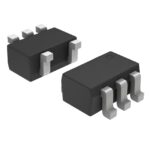 UMC5N-7
The activity of extra discounts on wholesale prices is in full swing…
Please fill in your contact information and we will send you the latest wholesale price list.




